by jphilo | Jan 29, 2010 | Different Dream, School/Education, Special Needs Parenting
In the previous post, you met Jennifer Peter, an Iowa professional learning and leadership consultant. If her explanation of the difference between Individualized Education Plans (IEPs) and 504b plans was helpful, you’ll also appreciate her answer to this question: What advice do you have for parents about how to maximize services for their children with special needs?
Services for Preschoolers
Jennifer explained that from birth to age three, services are set in motion by a referral from a medical professional, usually a doctor, to the local early childhood program office. Once the referral is made, the office has 45 days to meet with the family, and determine what services are needed. From birth to three, most services are provided in the home. From ages three to five, services are delivered in a pre-school setting if possible, where children are integrated with other kids.
So if you think your child needs special services, talk to your doctor about your concerns immediately. Be persistent. Early intervention can be highly successful.
School-Aged Children
Once children reach school age, their disability must affect their educational progress to qualify for educational services. Schools are not required to provide remediation for a medical diagnosis that don’t affect a child’s ability to learn. But they must provide accommodations so a diagnosed medical condition doesn’t prevent instruction or learning. You can find a more detailed discussion of Jenn’s advice on this topic at Which Do You Need: IEP or 504b?
State Vocational Rehabilatation
As a child approaches adulthood, Jenn encourages parents to explore all available avenues for support and services. If your child needs adaptive equipment to achieve gainful employment, your state’s vocational rehabilitation program may have the funds to pay for them. They may also pay part of college tuition. Other state programs provide funding to make a van handicapped accessible. Organizations like Easter Seals provide portalifts. If there’s a national foundation for your child’s condition or disease, they may have equipment loaner programs or education scholarships, too.
The key, no matter the age of your child, is persistence. Keep at it. Keep looking. Keep an open mind, and see what you find. If your persistence has paid big dividends, or you’ve found assistance in unexpected places, please share your story. Maybe it can help someone else, too.
Do you like what you see at DifferentDream.com? You can receive more great content by subscribing to the quarterly Different Dream newsletter and signing up for the daily RSS feed delivered to your email inbox. You can sign up for the first in the pop up box and the second at the bottom of this page.
by jphilo | Jan 27, 2010 | Different Dream, School/Education, Special Needs Parenting
In a recent interview with Iowa professional learning and leadership consultant, Jennifer Peter. She explained the difference between an Individual Education Plan (IEP) and a 504b plan. Her explanation was so elegant and clear-cut, you deserve to hear it, too.
IEP
Schools are required by federal law to create IEPs for any school-aged student who has been tested and identified as needing special education assistance. IEPs are educational tools. They focus on remediating significant learning problems through instruction, not through medical treatment or physical means. Many students with IEPs have no physical disabilities.
504b
504b plans are for students who need environmental accommodations so their physical disability won’t hinder their education. Students with disabilities requiring 504b plans may need no extra learning assistance, just some simple accomodations to remove physical barriers. Or they may need help with a physical disability or condition such as extra room for a child in a wheelchair, insulin shots for diabetics, an amplification system for a child with hearing loss, or help with a colostomy bag for a student with spina bifida.
Educational vs. Medical Diagnosis
Students with IEPs have an educational diagnosis, usually through the school system. Students with 504b plans have a medical diagnosis from a health care professional. Jennifer gave this example. “Learning disability is an educational diagnosis. Dyslexia is a medical diagnosis.”
Which One’s Right for Your Child?
Some students, those with both learning and medical issues, may have an IEP and a 504b plan. But if your child has learning issues, you need to pursue school testing, not a medical diagnosis. If your child has a medical condition that needs accomodation, you need a 504b plan from a doctor.
If you’re still puzzled, don’t feel bad. I taught school for 25 years and didn’t fully understand until Jenn cleared up my confusion. But if you have questions or another way to explain the difference between IEPs and 504bs, leave a comment. I’ll be glad to get back to you!
Do you like what you see at DifferentDream.com? You can receive more great content by subscribing to the quarterly Different Dream newsletter and signing up for the daily RSS feed delivered to your email inbox. You can sign up for the first in the pop up box and the second at the bottom of this page.
by jphilo | Dec 28, 2009 | Different Dream, School/Education, Special Needs Parenting
Before the holidays, a post on this blog featured toy guides geared for families with special needs kids. In a similar vein, today’s post puts the spotlight on a company designed to help parents and educators meet the needs of autistic children.
Different Roads to Learning
According to their website Different Roads to Learning was founded in 1995 by the mother of an autistic child. The company “carries over 450 products carefully selected to support the Autism Community.” If your child has a diagnosis somewhere on the autism spectrum, this site will be of interest to you and the educators in your son or daughter’s life.
Julie Azuma
Julie Azuma, the mom who started the company is as interesting as her site. You can read more about her at Jennifer Choi’s blog, canmombecalm.com. The contest mentioned in the post is history, but Julie’s story shows how much an ordinary parent can do. Maybe her story will inspire you to contribute to the special needs community in an unexpected way. Or maybe it will remind you of things you’ve already done.
Either way, leave a comment about how Julie motivated you.
Do you like what you see at DifferentDream.com? You can receive more great content by subscribing to the quarterly Different Dream newsletter and signing up for the daily RSS feed delivered to your email inbox. You can sign up for the first in the pop up box and the second at the bottom of this page.
by jphilo | Nov 13, 2009 | Different Dream, School/Education, Special Needs Parenting
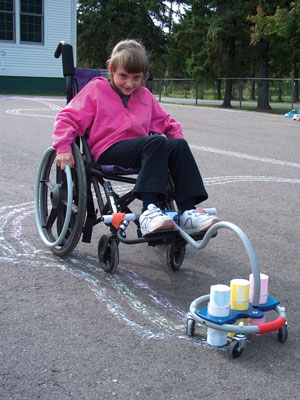
Kids and sidewalk chalk go together, don’t you think? But throw a wheelchair or a walker into the mix, and it becomes almost impossible for some kids to enjoy this childhood delight. Now, thanks to Dwayne Szot, children with disabilities can enjoy sidewalk chalk and a whole lot more.
Dwayne Szot
Dwayne is the founder of Zot Artz studio in Bayfield, Wisconsin. He’s also the inventor of a collection of adaptive art tools. According to his website, “Arts For All art tools are one-of-a-kind products that offer individuals of all abilities an opportunity for creative expression through arts and mobility. Art tools are designed so participants with limited movement or lack of fine motor skills can be successful in using what mobility they have to create, paint, draw, print and more. Individuals will roll out paint and draw with chalk – all while working on mobility skills and coordination through creative expression.”
ZotArts.com
You can learn more about Dwayne’s inventions (my fav is Major Bubbles), workshops, art boxes, and tool lending program at Zot Artz Arts for All. Be sure to browse through the online catalog where the pictures are worth a thousand words. If the equipment and workshop prices are beyond your budget, don’t lose heart. Check with your state Art Council. They may have grants available to cover part of the costs.
If you have any comments about ZotArts.com, leave them below. Your ideas are important!
Do you like what you see at DifferentDream.com? You can receive more great content by subscribing to the quarterly Different Dream newsletter and signing up for the daily RSS feed delivered to your email inbox. You can sign up for the first in the pop up box and the second at the bottom of this page.