by jphilo | Jan 19, 2012 | Advocacy, Different Dream, Special Needs Parenting
Okay, raise your hand if you’re are parents of kids with special needs under the age of 18?
Now, raise your hand if you hope to one day be parents of kids with special needs over the age of 18?
Uh-huh, that’s what I thought. Almost all of you raised your hands both times. Which means today’s post by guest blogger Kathy Guzzo is a crucial read for all of you. Even if your child is a babe in arms now, one day you’ll be glad you know what to do to guide your child with special needs into adulthood.
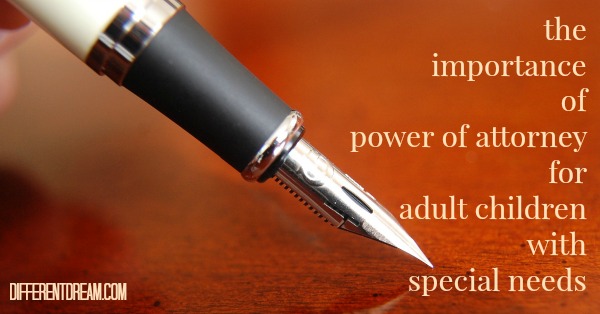
Special Needs Power of Attorney & Medical Authorizations
Just weeks before entering her freshman year of college our daughter was diagnosed with Systemic Lupus and a few months later Epstein Barr Replication. Both caused severe complications in the years to come. Having worked in an attorney’s office for years, I knew the importance of powers of attorney for property and healthcare (also known as Living Wills), for myself, but it was through trial and error I learned how imperative it was to have them for my children as soon as they turned 18 years of age, especially when dealing with medical conditions.
Why is a Special Needs Power of Attorney Needed?
The purpose of a power of attorney for healthcare is to allow the designated party access to information regarding the person’s personal health information from diagnosis of an illness to clarifying billing information and even contacting the health insurance company. According to The Health Insurance Portability and Accountability Act (HIPAA) regulations, as soon as a child turns 18 it is unlawful for any medical provider to release information on that child to anyone other than the patient, unless a power of attorney is on file. I should note that some providers might require their own medical authorization signed by the patient even if there is a valid power of attorney. This isn’t necessary, but for many offices it’s policy. Our daughter solved the question of what document to use when, by taking a copy of her power of attorney to her first appointment with a doctor and then asks at that time to sign a medical authorization.
When to Use a Special Needs Power of Attorney
There’s been many times in our daughter’s lengthy illness that I have needed access to medical information, thus having to utilize the power of attorney such as:
- To schedule and/or verify any type of medical appointment.
- To obtain an update on medications.
- To discuss with nurse and/or doctors comments, instructions, test ordered, etc. made by a doctor during a recent visit, especially when I was unable to attend because of scheduling and/or logistics. There were times Andrea was overwhelmed by information she was given and with her college schedule she was extremely busy so it was helpful to both of us that I could call for explanations.
- To ask about a new symptom or possible reaction to medication.
- To obtain information via telephone when she was hospitalized.
- To obtain copies of any records and test results.
- To be able to discuss a charge or balance of a medical bill with the billing department because even though Andrea was still on our insurance, when she turned 18 the bills were in her name so the provider wouldn’t discuss it with me without a power of attorney or a signed medical authorization from their billing department.
- To be able to discuss Explanation of Benefits (EOB) with a customer service representative. It’s highly beneficial to understand the insurance policy’s benefits, copays, network, etc. when making these calls.
There may still be times when the office representative won’t be cooperative or understand the reason a parent is calling for an adult child. In fact, I once had an employee in a billing department actually say, “It must be nice for your 23 year old daughter to have you handle her bills”. My first reaction was to tell her she had no idea all that Andrea deals with on a daily basis, but instead I ignored the comment and got back to the issue at hand. I had the necessary documents and she was obligated to give me the information requested.
Special Needs Power of Attorney Is Priceless
For a young adult trying to figure out life and all the responsibilities that go along with it is tough. But for a young adult with a chronic illness everyday life can be overwhelming because of all that’s involved in managing their illness while not feeling well. That’s why I was glad Andrea had signed the necessary documents not only for an emergency health situation, but so I could help alleviate some of the stress caused by medical bills and constantly dealing with health insurance approvals, denials, wrong coverage, etc. Having powers of attorney prepared by an attorney is relatively inexpensive, yet the value they are to the parents of a chronically ill adult child is, as they say, “priceless.”
What Do You Know about Special Needs Power of Attorney & Medical Authorizations?
Whoa, do you need some time to absorb everything Kathy had to say? Do you have questions you want to ask? Similar experiences to share? In any case, leave a comment to join this important discussion.
Do you like what you see at DifferentDream.com? You can receive more great content by subscribing to the quarterly Different Dream newsletter and signing up for the daily RSS feed delivered to your email inbox. You can sign up for the first in the pop up box and the second at the bottom of this page.
Save
Save

by jphilo | Jan 12, 2012 | Advocacy, Different Dream, Special Needs Parenting
Do you remember when your children took their first steps? Are you still waiting for the day to come? Are you wondering if it will ever come? As today’s post shows, guest blogger Ellen Stumbo knows how you feel, whether your child learned to walk easily, needed extra help, or hasn’t yet accomplished the feat – no pun intended.
First Steps Take Courage
There was no hesitation, no wobbly steps, no loosing balance. When Ellie began to walk, that is what she did. She walked. She pushed herself to a stand in the middle of the kitchen and walked straight to me. A first that somehow defined precision.
On the Other Hand
Nichole, on the other hand, had muscle tone to conquer. Low muscle tone is one of the characteristics of Down syndrome, so we knew walking would take a little bit longer. Moreover, a lot of work; with a good measure of determination. Physical therapy became a regular part of our weekly routine. Nichole would dangle from a harness over a treadmill where we worked on walking. We did this for months. At first, she would only walk using a push toy. She was going to walk independently in her own time. Not ours and not her therapists. Her own time.
Triumph!
She was almost 2 years old, and I feared I would miss her first steps. We were heading to Ukraine to adopt our third daughter, and the thought of missing a milestone we had worked so hard to achieve felt devastating. A few weeks before getting on a plane to fly across the globe, Nichole stood; she took 3 wobbly, unbalanced, clumsy steps and fell down on her behind. I jumped, I cheered, I clapped, I cried. She clapped with me, pride exuding from her 23-month-old body. A first that somehow defined triumph.
A Fight for Balance
Now I have a third child. One that makes me long to witness those first steps one more time. Nina’s body, tight from cerebral palsy, fights to find balance, coordination, and strength. Her kindergarten friends run free in the playground, they move around without restrictions. Nina watches. I know she wants to walk. Fear and lack of self-confidence tie her down to her wheelchair. Her walker gives her some independence, but her stamina only lasts so long.
“You Can’t!”
Nina wears resignation around her neck; she does not want to take it off. She spent too long left alone in a crib. Without someone that would believe in her, in her potential. Her first English words were “I can’t!” And my heart breaks for her. The powerful message she received in a cold orphanage in Ukraine continues to whisper in her ear, “You can’t!” Nina believes it.
I Will Not Give Up!
However, I am not giving up on her. I will be her legs if I have to, but I will teach her to use her own. We will cry, we will be frustrated, and we will get tired. But I am not giving up. I am her mother. Some day, she will walk independently. Some day, she will believe that her body can physically do it. It will be an emotional first. A first that somehow will define courage.
How Do You Keep Your Child from Giving Up?
Thank you, Ellen, for once again showing us how to advocate for our children, how to keep going for them when they don’t think they can. What have you done to keep your child from giving up? Leave a comment to encourage and inspire. Or ask for advice if you need encouragement today.
Do you like what you see at DifferentDream.com? You can receive more great content by subscribing to the quarterly Different Dream newsletter and signing up for the daily RSS feed delivered to your email inbox. You can sign up for the first in the pop up box and the second at the bottom of this page.

by jphilo | Jan 11, 2012 | Advocacy, Different Dream, Special Needs Parenting
Guest blogger Scott Newport is back today with news of a recently completed project at C.S. Mott Children’s Hospital in Ann Arbor, Michigan. Maybe it will inspire you to give back to the hospital where your child was treated. Read on!
In the Midst
I can still remember those days, times when I wasn’t sure where it would all lead. Like many parents of children with serious medical conditions we have all been in those cold, hospital rooms wondering what the next test result would unveil. Sometimes we can’t even think straight, we’re just numb. Being surrounded by medical equipment and beeping alarms doesn’t help.
A couple of weeks back a pediatric I.C.U. nurse walked up to me and asked if I could help her. “Hey Scott, now that we’re in the new hospital we noticed a few things needing improvement.” She went on to tell me there was a lack of privacy for patients and families at times. She was wondering if I could build a portable privacy wall they could put up when needed.
I immediately became excited to help. That night while lying in bed I realized I would need a theme for my project and quickly understood a Sponge Bob collage would not do. “What about a seasonal theme,” I whispered to myself. I could have four panels, each with a different time of year displayed. I imagined what it might be like for a family surrounding a child who may not make it.
I talked to a local Michigan artist and together in the midst of her studio the privacy wall was created. I also thought it would be cool to decoupage a poem on the back adding a little more meaning. When I put the last hinge on the panels and opened it, I cried.
Hope you like the poem and the photo of the Aspen forest in the midst of the privacy screen.
Hinged
Unfolding thoughts
Read only to me
Layered emotions
Add creaking dimension
One side opened
The others angled-
Away, or towards
Depending on the swing
Of the Aspen
Forest I’m in
Pivoting Blue sky,
White shadows
Shimmering, yellowed
Wood
In the distance
No road in sight
Roots fastened
Hidden by
Wild flowers
Blossoming
****
Still open
What Simple Kindnesses Have Helped You?
Scott’s screen was a simple kindness, one of those little things that makes the hospital a better place. What kindnesses touched you when your child was in the hospital? What kindnesses have you extended to other parents and families? Leave a comment.
Do you like what you see at DifferentDream.com? You can receive more great content by subscribing to the quarterly Different Dream newsletter and signing up for the daily RSS feed delivered to your email inbox. You can sign up for both in the upper right column on this page.

by jphilo | Jan 10, 2012 | Advocacy, Different Dream, Special Needs Parenting
January is EA/TEF Awareness Month.Therefore, each Tuesday post at DifferentDream.com in January is dedicated to raising awareness of the birth anomaly that affects our first child and approximately 1 in every 4000 babies born.
10 Reasons to Mark EA/TEF Awareness Month in January
Last week’s Tuesday post listed 10 reasons to mark EA/TEF Awareness Month. Many of you listed your children (and some EA/TEF survivors listed themselves) as more reasons to mark the month. Thank you so much for sharing your stories and reminding all of us that the EA/TEF family is wide and deep.
EA TEF Awareness Is Why I Write
This week’s post gets up close and personal. (Anybody else out there old enough to remember that slogan from the news coverage from the Winter Olympics way back when?) It’s a piece I wrote in December for a guest post for an author friend of mine, Melissa Tagg, an up and coming fiction writer who is on the verge of publication. (When you read her first book, remember you heard about her at DifferentDream.com first!) She asked me to blog about how my past experiences influence my writing. The resulting post, altered slightly, is a perfect fit for EA TEF Awareness Month. See what you think.
Helping Faith Take Root
My husband came home from work a few weeks before Christmas with good news and bad news. The good news was that a co-worker had just become a grandfather. The bad news was that the newborn boy had a heart anomaly and wasn’t doing well.
“Can I give the family copies of your books?” my husband asked.
Now, you would think my answer must have been an immediate yes. But it wasn’t. I didn’t say a thing because I was busy thinking, “I have given so many books away already. Will anybody ever buy them? Will my writing income ever be greater than the expenses?”
A shocking internal reaction, don’t you think?
Thankfully, dollar signs didn’t hold my thoughts hostage for long. I remembered our son’s first December. Allen was seven months old by then and had endured two Lifeflight helicopter rides, two major surgeries, three hospitalizations, and dozens of medical tests and treatments to correct a type C EA/TEF. He’d recently transitioned from tube feeding to using a bottle to take in the breast milk I pumped for him four times a day. My husband and I were exhausted by lack of sleep, constant worry, and frequent trips to the hospital, a 240 mile round trip from the remote South Dakota town where we lived.
What kept us going?
The encouragement of friends and neighbors in the tiny town where we lived. While Allen was hospitalized for three weeks after his birth, they cleaned our house, cared for our garden, and sent notes. Once we brought Allen home, a pastor and his wife came every week to do a Bible study with us and answer our questions about why a loving God would allow a little baby to endure so much. A local fundraiser in November netted over $1500.
For a town with a population of 92 in a county of about 1500, it was big money!
As Christmas drew closer, the familiar story of a baby in a manger held new meaning to me. For the first time, as the parent of a precious child who had experienced great pain, I understood the magnitude of God’s gift to mankind. He sent his Son to a world stained by sin and evil, even though he knew the pain Jesus our Savior would bear. What joy to be loved by a God willing to sacrifice so much to save us from our sin.
My faith and gratitude grew deep roots that Christmas.
Roots that waited more than two decades to bear fruit. The fruit took the form of two books full of resources and encouragement and answers for parents facing the same exhaustion and doubts we once did. Two books for families like the man who works with my husband.
“Of course,” I said. “Take both books to them.”
The little baby had surgery a few days after that. Today we received word that he’s not getting better. The family is stricken, not up to reading anything. But one day they will start looking for encouragement. One day they will ask hard questions. Depending on the answers they find, their faith will either shrivel and die or take root and grow.
I’m praying that these books will help their roots to grow.
Do you like what you see at DifferentDream.com? You can receive more great content by subscribing to the quarterly Different Dream newsletter and signing up for the daily RSS feed delivered to your email inbox. You can sign up for the first in the pop up box and the second at the bottom of this page.

Save

by jphilo | Jan 4, 2012 | Advocacy, Different Dream, Special Needs Parenting
Nine Reasons to Mark EA TEF Awareness Month
Most people in the northern hemisphere associate January with breaking resolutions made with the best of intentions, making the best of cold and dark and snow, and spending three weeks forgetting to record the day’s date with the number of the new year instead of the old one. But some parents associate January with EA TEF Awareness Month because we’re the parents of kids born with esophageal atresia, also known as tracheoesophageal fistula. Why is it important to raise awareness of EA/TEF each January? Here are 9 good reasons:
#9: Most People Haven’t Heard of EA/TEF
It’s hard to believe this condition is relatively unknown when 1 in 4000 newborns are diagnosed with it.
#8: About One-Half of Babies Born with EA/TEF Will Have Trouble with GERD
Gastroesophageal Reflux Disease (GERD) is most often associated with adults who have chronic heartburn. But EA/TEF babies often deal with GERD (our son did and still does) because the esophageal sphincter valve into the stomach is not formed correctly or is missing. Untreated GERD can result in Barrett’s esophagus, a precancerous condition.
#7: Children with EA/TEF Tend to Vomit Often
We’d like you to know our kids don’t have the stomach flu when they throw up in the restaurant. A EA/TEF esophagus has strictures that sometimes won’t let the food go down, especially if something gets stuck. So our kids sometimes have to throw up.
#6: Children with EA/TEF Are Born with Some Form of Tracheomalacia
Our doctor described tracheomalacia as a trachea without the cartilage fully developed. Therefore, the trachea walls are floppy, and the baby’s breathing sounds wheezy and asthmatic. Our doctor said the cartilage would eventually form, and our son’s did. But his breathing was wheezy and his cough very barky until about age 5. By then, we were all pretty tired of the nasty looks and comments from strangers when they heard his croupy sounding cough.
#5: Because Treatment of EA/TEF Hasn’t Improved by Leaps and Bounds
Our son was born in 1982 when pediatric surgery was just emerging from the dark ages. In the 30 years since, treatment hasn’t changed very much, at least not when compared to treatment for kids with pediatric cancers and other, better known childhood ailments. With greater awareness comes a greater push for change.
#4: Because EA/TEF Is Rarely Prenatally Diagnosed
The prenatal clues to EA/TEF are a small stomach or no stomach bubble, high levels of amniotic fluid, and vessel cord anomalies (2 vessel cords). If a mother has any of those conditions, she could ask her doctor to move her delivery to a hospital with a high level NICU. Then the baby won’t be separated from the mother if surgery is required.
#3: Grey’s Anatomy Recently Featured EA/TEF in an Episode
Hey, we’re on an awareness roll. Let’s keep it going! Season 8 Episode 9, called Dark Is the Night, featured EA/TEF!
#2: Guest Blogger Lori McGahan’s Son Brandon Is an EA/TEF Kid

Lori is passionate about raising awareness concerning EA/TEF. Check out Bridging the Gap of EA/TEF, the Facebook page she created. It is packed with information.
#1:My Son Allen Was an EA/TEF Baby, Too
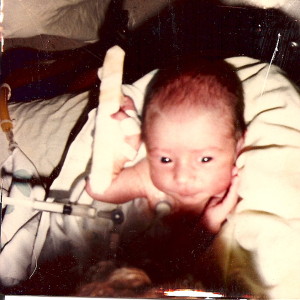
No parent can forget the moment of diagnosis, sending a precious baby off to surgery instead of taking him home. Those who have walked that road want to accompany other parents who are still on the journey. We want to help them bridge the gap between their dreams and reality.
More Reasons for EA TEF Awareness Month?
What reasons do you have for marking EA TEF Awareness Month this January? Leave a comment!
Do you like what you see at DifferentDream.com? You can receive more great content by subscribing to the quarterly Different Dream newsletter and signing up for the daily RSS feed delivered to your email inbox. You can sign up for the first in the pop-up box and the second at the bottom of this page.
Jolene Philo is the author of several books for the caregiving community. She speaks at parenting and special needs conferences around the country. Sharing Love Abundantly with Special Needs Families: The 5 Love Languages® for Parents Raising Children with Disabilities, which she co-authored with Dr. Gary Chapman, was released in August of 2019 and is available at local bookstores, their bookstore website, and Amazon. See Jane Dig!, the fourth book in the West River cozy mystery series, which features characters affected by disability, was released in October of 2024.
Subscribe for Updates from Jolene

by jphilo | Dec 21, 2011 | Advocacy, Different Dream, Special Needs Parenting
Guest blogger Ellen Stumbo has been thinking about an issue important to parents of kids with special needs: how to be an effective advocate. In today’s post, she shares about how her perception of effective advocacy has changed and mentions a good book put out by Wrights Law, an organization that trains parents to advocate for their kids in school.
Am I an Effective Advocate?
Speak up for those who cannot speak for themselves, for the rights of all who are destitute.
Speak up and judge fairly; defend the rights of the poor and needy.
Proverbs 31:8-9
When Nichole was born with Down syndrome I began to learn as much as I could about her condition. I felt the need to become an expert and help educate people. I was passionate and vocal…really vocal. I had become her advocate, but was I an effective advocate? This is a thought I have been processing lately, because in order to see positive results, I need to be an effective advocate.
Advocacy in the Early Days
You see, when Nichole was a baby, I was learning how to be the mom of a child with special needs. Out of my great love for her, I wanted others to see her just the way I saw her. I wanted people to understand Down syndrome and see the beauty I saw.
Looking back, I believe that sometimes my “all-out” ways stunted me from being an effective advocate and perhaps even approachable. I know I spent energy focusing on weather people used People First Language, or if they used the correct terminology or up-to-date information. I did not expect people to be at the same level of awareness I was, but I think maybe I did expect them to arrive to the place where I was once I had explained the ins and outs of Down syndrome. I wonder how many people felt overwhelmed by me.
I was learning to do life with Nichole, and the many layers of my life touched by Down syndrome. She is only 3 years old, and I still have a lot to learn. However, Down syndrome is so common for me, and for our family, that I believe I can look more objectively at what an effective advocate is. After all, I now have 2 girls to advocate for. (Actually, make that 3, Ellie needs her mama to advocate for her at times.)
Advocacy Now
Why am I thinking about this right now? I just got the book From Emotions to Advocacy and I am learning about being an advocate in the school system. This book, however, has challenged me in the “personal level” advocacy, and the many times that I have allowed my emotions to take over. Effective advocacy happens when emotions are under control, it is hard to advocate when you are angry, or hurt by a comment or an action.
Advocacy to Change Lives
But being Nichole’s and Nina’s advocate means that I get to practice Proverbs 31:8-9. I get to speak up for Nichole and for Nina, for their rights, and for their needs. Why? Because I want to see Nichole and Nina’s lives changed, I want them to thrive! Regardless of their disabilities, they have great potential, they have gifts and talents to contribute to those around them.
How Have You Changed as an Advocate?
Can you identify with the change Ellen has been experiencing lately? I certainly can. What are some ways you’ve changed as an advocate? What tools and resources have you discovered? Share your wisdom by leaving a comment.
Do you like what you see at DifferentDream.com? You can receive more great content by subscribing to the quarterly Different Dream newsletter and signing up for the daily RSS feed delivered to your email inbox. You can sign up for the first in the pop up box and the second at the bottom of this page.