PANS: Early Diagnosis Is Key

PANS: Early Diagnosis Is Key

PANS: Early Diagnosis Is Key

PANS is a puzzling condition. Guest blogger Lisa Pelissier’s world changed after her child had a bout of food poisoning. She tells her story in this post in hopes that other parents will recognize its symptoms so their children can receive crucial early treatment.

I have four children. One of my other children has high-functioning autism or Asperger’s Syndrome, depending on whom you ask. That child has always been an unusual character, full of funny quirks and troublesome issues. Despite the fact that that child is an amazing human, I had always worried.

I had never worried about my neuro-typical child.*

This was my neuro-typical one. The one without any issues. The one with the constant enthusiasm for life. The one with the drive to excel. The one with eyes that sparkled with mischief. This child was fine.

At age twelve, my child came home from summer camp with food poisoning. The whole group was barfing; three of them were sick enough to get sent home. Mine was one of them. That was in July.

By September my child’s stomach was better but my child still wasn’t eating much. And then there was the soul-crushing, life-strangling OCD. Our lives turned into a nightmare. My child couldn’t do anything except hang on to the beloved pet lizard like life itself depended on it. My child’s mind stopped functioning. My child’s handwriting became the scrawl of a kindergartener and there were often holes in school papers because of the extreme pressure my child exerted every time the letter “L” occurred.

The pediatrician said teenagers oftentimes “need counseling”.  I was sure the psychiatric symptoms were related to the food poisoning but no one would listen to me. We tried supplements. We tried changing my child’s diet. After six months of the nightmare we went to a psychiatrist who prescribed medication for the OCD. It helped. It didn’t fix the problem, but it diluted the symptoms. We were still at sea, but at least my child’s nostrils were above water.

My child had been sick for a year and a half when I first heard of PANS. A friend mentioned that her son had this unusual disorder called PANS. That stands for Pediatric Acute-onset Neuropsychiatric Syndrome. She didn’t say much about it so I googled it when I got home. Point for point, it described what had happened to my child. The pediatrician still scoffed. Alternative medicine didn’t help. Changes to diet only made my child more stressed.

PANS is best treated if it’s caught early, but I didn’t have a name for it for the first year and a half my child was sick. It’s in the hope that someone else will catch it earlier, that someone else’s child and family won’t have to endure what we’ve been through that I’m writing this.

My brilliant child, my sparkling child, my ambitious child was gone. This child squeaked through school and came out the other end the worse for the wear. School was meaningless. It was just more anxiety, more pressure. When I look back at pictures from the early days when my child was so sick I can see it in my child’s eyes… blank despair, dark circles, anxiety. I did the best I could be there was nothing that helped. Looking back I feel like there should have been more I could have done. I should have known sooner. I should have insisted. I should have done a million things better than what I did. I’d failed.

But the biggest failure was that my child wasn’t diagnosed earlier. Early diagnosis is key.

By the grace of God, my child is improving. But my child may always deal with this invisible disability.

Please watch for the symptoms of PANS, especially following an illness. I hope that if this is your child, you will be able to get help before the condition progresses.

  • Sudden-onset OCD
  • Regression in schoolwork, especially handwriting
  • Irritability
  • Reluctance to eat or picky eating
  • Behavioral regression
  • Clinginess
  • Anxiety or depression
  • Sleep Disturbance
  • Urinary Frequency

 I’ll probably never understand why this hardship came to my child. But I praise God. My child has never asked why. This child never blamed me. This child had accepted illness with much more grace than I have. My child is still the same amazing kid, despite the heavy burden to bear. God has been faithful to walk the path with us, but He didn’t keep us from it.

Psalm 119:75-76 says “I know, O Lord, that Your judgments are righteous, and that in faithfulness You have afflicted me. O may Your lovingkindness comfort me, according to Your word to Your servant.”

*This child asked me to only reference him or her as “my child” in this article.

Do you like what you see at DifferentDream.com? You can receive more great content by subscribing to the monthly Different Dream newsletter and signing up for the daily RSS feed delivered to your email.
By

Lisa Pelissier lives in Oregon where she is a homeschooling mother of four (three with disabilities) and author of two middle-grade fiction novels. Lisa owns SneakerBlossom Books, offering Christian, classical homeschool Study Guides and curriculum. She also works as a freelance copy editor, an artist, and a tutor. In her spare time Lisa enjoys playing the piano and fretting about things over which she has no control. Email Lisa at sneakerblossom@yahoo.com or connect on Facebook.

Author Jolene Philo
Archives

Categories

Subscribe for Updates from Jolene

Related Posts

Pets and Kids with Special Needs

Pets and Kids with Special Needs

Pets and Kids with Special Needs

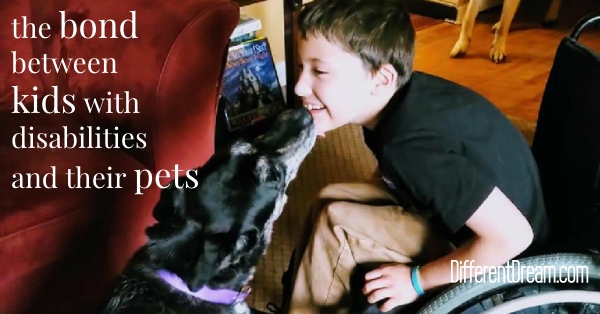
Pets and kids with special needs is a topic that is always near and dear to guest blogger Trish Schaeffer’s heart. Today she presents evidence about why pairing pets and kids with special needs is beneficial as a way to honor a pet who loved Alex, her son who lives with special needs.

 “Many professionals argue that animals are able to perceive people’s physical and developmental disabilities and are able to adapt to them. To date, there is no scientific evidence in support of this hypothesis” So states a quote by one scientist out there somewhere. 

I beg to differ. 

Pets help kids with disabilities. The keen senses of pets can detect seizures, dips in blood sugar, remove obstacles, and alert caregivers. They can even remind young owner to take medications. 

Pets are highly intuitive when it comes to sensing pain or illness and have instincts for giving assistance to their owners. They also give an astounding level of protection to their young charges. They are known for decreasing social anxiety and stress. 

Many pets do not have special training but they still help kids with disabilities. They seem to gain an understanding of the needs and differences of a disability or special need. They behave as if they know and understand their children. They purr, encourage play, and assist with mobility.

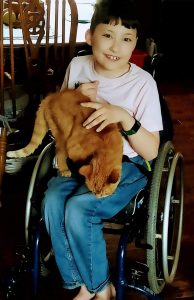
 I can bear witness to this. Our 2 cats and 2 dogs understood Alex’s differences and disability. Each one in their own way adapted and offered assistance without formal training. One cat would alert to seizures out of the blue.

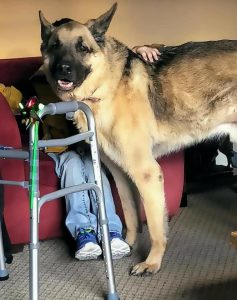
Our pets would take turns laying beside Alex after surgeries and when he was ill, as if protecting and comforting. Our biggest dog allowed Alex to use his body to assist with sitting on the floor and standing. That dog’s actions helped teach Alex how to sit up unassisted over the years. Another dogs sensed his sadness and comforted him by allowing as many hugs as Alex wanted. 

It blows my mind, that with no formal training our pets understood and gave Alex a helping hand–or paw. To me that demonstrates the unshakable bond of love, acceptance, and understanding animals offer, regardless of someone’s disability. We as humans should take notes from the relationships of pets and kids with special needs.  

Author’s note: This article is hard to write even now as our bigger dog I have mentioned went over the rainbow bridge in June of 2021. I want to honor Toby’s undying service to Alex over the last 11 years. To honor his love and acceptance and truly becoming Alex’s best friend. May you run free Toby and no longer be in pain until we see you again. 

Do you like what you see at DifferentDream.com? You can receive more great content by subscribing to the monthly Different Dream newsletter and signing up for the daily RSS feed delivered to your email.

By

Trish Shaeffer is the mom of 3 active boys, 2 of whom have special needs. She’s a peer supporter for Parent to Parent and volunteers with the United Cerebral Palsy Network, Special Olympics, and the United Way. She’s also an equine volunteer at Leg Up Farm. She’s married to her best friend and biggest supporter, Chris Schaeffer.

Author Jolene Philo

Archives

Categories

Subscribe for Updates from Jolene

Related Posts

Expectation Versus Reality TV

Expectation Versus Reality TV

Expectation Versus Reality TV

Expectation versus reality TV came into focus for guest blogger Trish Shaeffer during the pandemic. She found the gap between the portrayal of individuals with disabilities on television and what life is like for them to be wide and unrealistic. What she saw resulted in several questions she’s sharing today.

While stuck at home more for the last year due to Covid-19, I caught up on a lot of TV. As I scrolled through countless options for scripted and reality shows, questions began to form in my mind.

Why aren’t there reality shows about parents with special needs kids?
Why aren’t there reality shows about people living with disabilities?

In today’s world people are fighting for change and protesting for the rights of many individuals. But it seems that the disabled population had been forgotten and put into the background of rights, understanding, and love.

Are they not people too?When did disability rights become a touchy subject?
Why does it seem the world has forgotten about them?
Why is there a stigma about how we title people with disabilities?

I did a poll online to get a better understanding of how and why people have different opinions on how to address the issue. I got feedback. For sure. It turned into a heated debate. My question at the end of the poll was this simple. Why don’t we give people with disabilities their own individuality?

Why don’t we begin by addressing adults with disabilities by their name?
Once we know their names, why don’t we ask the person how to address them?
Why don’t we ask a child or the child’s parents their names, address the child by name, and ask the parent or child how they prefer to be addressed?
It is that simple.

I keep going back to my original question about the lack of reality shows about someone living with a disability or about parents raising a child with a disability. If there was such a show, maybe the stigma about those with disabilities would stop.

Maybe the world would understand how to address a person with disabilities.
Maybe those shows would increase compassion and love toward the disabled community.
Maybe people wouldn’t feel awkward when they encounter a person in a wheelchair because they will know how to start a conversation.
Maybe parents of typical kids will understand the daily struggles of special needs parents instead of judging and staring.
The possibilities are endless.

Being a special needs parent is full of ups and downs. It is hard but full of reward as well. Being a person disabilities is also full of ups and downs. Success and struggles. It’s a world no one will truly understand unless they live it. But, a show about it will open doors, possibilities, compassion, and give people and insight. My son would benefit from seeing someone like him overcome or deal with a disability. Some one he could relate to.

So I ask you as the reader, would you like expectation versus reality TV to come into focus for you?
Would you like to see a reality show about being a special needs parent?
What about a show about someone living with a disability?

Let’s end the stigma about the disability community.

Let’s spread love, acceptance, and understanding.
Let’s talk about disability rights.
Let’s end the expectation versus reality TV disconnect.
Let’s use reality television to do it.
Come on TLC or Discovery!
Let’s make a show happen!

Do you like what you see at DifferentDream.com? You can receive more great content by subscribing to the monthly Different Dream newsletter and signing up for the daily RSS feed delivered to your email inbox. You can sign up for the first in the pop up box and the second at the bottom of this page.

By

Trish Shaeffer is the mom of 3 active boys with special needs. She’s a peer supporter for Parent to Parent and volunteers with the United Cerebral Palsy Network, Special Olympics, and the United Way. She’s also an equine volunteer at Leg Up Farm. She’s married to her best friend and biggest supporter, Chris Schaeffer.

Author Jolene Philo

Archives

Categories

Subscribe for Updates from Jolene

Related Posts

The Unkind Aftermath of the Pandemic

The Unkind Aftermath of the Pandemic

The Unkind Aftermath of the Pandemic

The unkind aftermath of the pandemic has become increasingly obvious on a personal level even as Covid cases and deaths fall. So far the improved statistics have had little effect on the aftermath our family is dealing with as our mother’s health declines.

Mom is 92. 

She’s lived in an assisted living memory care facility since 2015. She survived the pandemic without getting Covid. She endured a year without indoor visits from her family. She had no side effects from her vaccine. She was delighted when regular visits from her kids began in March of 2021. Soon after we began seeing the unkind aftermath of the pandemic as Mom’s health began to decline. 

Let me be clear.

Mom’s health issues are most likely not related to the pandemic. However, the blame for the difficulty we’ve experienced while trying to address her increased care needs is definitely related to the unkind aftermath of the pandemic.

  1. Rapid staff turnover. Mom’s facility and many others can’t hold onto direct care staff and nurses. To solve the issue they rely on temp agencies to cover shifts. The care provided by temporary staff is often quite good, but they aren’t there long or often enough to get to know clients’ names, much less develop relationships. 
  2. Poor communication. This rapid turnover results in poor communication. Calling to check on Mom’s status is hard when a direct care staff member doesn’t know who you’re talking about. When nurses leave, which happened where Mom lives just as her health issues began, there’s no one to do charting, no one to follow through on medication changes, no one who’s qualified to report to the doctor, and no one to assess care needs and update care plans. There’s also no one qualified to send a patient’s notes and records so other facilities can determine if someone qualifies for their level of care.
  3. Limited access. Elder care facilities aren’t embracing the no masks necessary indoors for vaccinated adults. Considering the death rate for Covid among the elderly, their caution is completely warranted. It also adds to the challenge of finding a new place for Mom to live. We rejected a facility right down the street because they only allow outdoor visits because Mom can’t do outdoor visits right now. Two facilities that do allow visits aren’t giving tours because the visits are limited to family members of residents. One facility allowed us to meet with the administrator in her office. At the other facility, we had to meet in the parking lot. We have to choose Mom’s new home sight unseen.

For those whose families are vaccinated and healthy, the unkind aftermath of the pandemic can be easy to ignore. For families caring for children with disabilities and special needs, for those who love adults with compromised health, and for those supporting the elderly through their last years, the aftermath continues to define and limit their lives.

Your kindness has the power to make a difference in those families.

Get vaccinated.
Wear a mask when around people who aren’t vaccinated.
Wash your hands.
Stay home when you’re sick.

The quality of Mom’s final years depends upon your small and significant acts of kindness.

Please.
Be kind.
For Mom’s sake.
Please.

By

Jolene Philo is the author of the Different Dream series for parents of kids with special needs. She speaks at parenting and special needs conferences around the country. She’s also the creator and host of the Different Dream websiteSharing Love Abundantly With Special Needs Families: The 5 Love Languages® for Parents Raising Children with Disabilities, which she co-authored with Dr. Gary Chapman, was released in August of 2019 and is available at local bookstores, their bookstore website, and at Amazon.

Author Jolene Philo

Archives

Categories

Subscribe for Updates from Jolene

Related Posts

Write Everything Down

Write Everything Down

Write Everything Down

“Write everything down,” my adult daughter said.

I stared at her, equally amazed by her wisdom and my epic fail to practice what I’ve been preaching for more than a decade. When I spoke at special needs and disability conferences—pre-pandemic of course—parents would ask how to be effective advocates for their kids. My top 3 tidbits of advice were always:

  1. Let people in.
  2. Don’t take no for an answer.
  3. Write everything down.

How had I forgotten my own best advice this spring while advocating on my mother’s behalf? I’m blaming my oversight partly on the pandemic (it’s about time it was good for something), and partly on my inability to see that effective special needs advocacy practices are equally effective while advocating for the elderly.

I tore myself away from staring in amazement at my daughter—when did she become so wise?—and went into my office where I began to write everything down as she had advised. That was about 2 weeks after Mom’s health issues began, and the timeline of events was still clear in my mind. At the time this post was written, the timeline had stretched to 4 weeks and counting. If my daughter hadn’t said to write everything down when she did, the increasing number of events would have become muddled and my recording of them inaccurate. Not good.

Because effective special needs advocacy practices can be applied effectively during elder care advocacy, and vice versa, let’s see how the other two tidbits of advice can work for both populations.

To read the rest of Write Everything Down, visit the Hope Anew blog.

Do you like what you see at DifferentDream.com? You can receive more great content by subscribing to the monthly Different Dream newsletter and signing up for the daily RSS feed delivered to your email.

By

Jolene Philo is the author of the Different Dream series for parents of kids with special needs. She speaks at parenting and special needs conferences around the country. She’s also the creator and host of the Different Dream websiteSharing Love Abundantly With Special Needs Families: The 5 Love Languages® for Parents Raising Children with Disabilities, which she co-authored with Dr. Gary Chapman, was released in August of 2019 and is available at local bookstores, their bookstore website, and at Amazon.

Author Jolene Philo

Archives

Categories

Subscribe for Updates from Jolene

Related Posts

What if Denying Self-Care Is an Injustice to You and Your Family?

What if Denying Self-Care Is an Injustice to You and Your Family?

What if Denying Self-Care Is an Injustice to You and Your Family?

What if denying self-care is an injustice to you and your family? Guest blogger Sandy Ramsey-Trayvick poses that question in today’s post. Her thought process is both convicting and empowering.

As special needs parents, many of us have advocated for our children educationally and medically to ensure the services or treatments they need to grow, heal, and thrive. 

As the mom of a son with special needs, I’ve been playing the role of advocate for over 20 years and have been pretty successful in gaining access to services my son might have otherwise not received. He, his classmates, and schoolmates have benefited because strong advocacy can affect real change. We can all attest to that.

I wonder what would happen if we advocated for ourselves as passionately as we advocate for our kids. In not doing so, how have we been deprived of the things we need to grow, heal, and thrive?

There is so much being shared about self/soul care these days.  The need for both, and ideas for how to address both, are well documented.  And yet these are still areas where special needs parents, especially moms, continue to struggle.

Why is that?  

The answer might lie in the mindset we need to adopt before we can prioritize self and soul care? Because advocacy is a response to a perceived injustice, What if denying self-care is an injustice to you and your family? With this perspective, would you then be more willing to advocate for your self and soul care?  Perhaps then we, as special needs parents, would be willing to:  

  • Look and advocate for solutions that make self-care possible.
  • Stand up against the voices that tell us we don’t need to care for our physical, spiritual and emotional health.
  • Advocate against the supermom/dad syndrome that drives so many of us to have unhealthy expectations of ourselves. Advocate for the truth that both we and our families fail to thrive when we don’t care for our own well-being.

With so many other things to do, it can often seem easier than not to let our own needs slide. In my case, the Lord Himself had to reveal that my mindset about self-care needed to change. Prior to His revelation, I’d never considered that sacrificing my own care did not line up with God’s desires for me. According to His exact words, the choices I was making to neglect consistent self-care were rooted in a disabled life mindset. He wanted me to make better choices for my well-being.

That’s so like God, isn’t it?  He doesn’t want anything to prevent us from fulfilling His good plans for our lives. He’s given us His Holy Spirit, the Advocate to help us. He’s willing to help us if we want to make better choices. But He won’t force us. So ask yourself these questions:

  • What if denying self-care is an injustice to you and your family?
  • What are some of the areas in which your self and soul could use an advocate?  
  • If you’re not sure, ask the LORD and His Advocate will guide you.

Do you like what you see at DifferentDream.com? You can receive more great content by subscribing to the monthly Different Dream newsletter and signing up for the daily RSS feed delivered to your email.

By

Sandy is wife to Terry, mom to 3 young adult children, a Bible study teacher, an encourager to those who are weary, a fitness enthusiast, a lover of books, and a certified professional coach. She and her husband are also marriage mentors. Twenty years ago, after her son was diagnosed with multiple disabilities, Sandy became his full time caregiver and advocate. She knows that living in the world of special needs or disabilities can lead to a “disabled life” mindset that focuses on limitations and settles for less life, less joy, less fulfillment. She coaches parents of children with special needs to help them see their circumstances from a perspective of hope, purpose, and opportunity. She helps them choose actions that create a life for themselves and their families that is joyful, fulfilling and fruitful. You can learn more about Sandy, her work, and her blog at www.UNDisabledLIVES.org.

Author Jolene Philo

Archives

Categories

Related Posts