Siblings of Kids with Special Needs: Do Their Lives Change?

Siblings of Kids with Special Needs: Do Their Lives Change?

Siblings of Kids with Special Needs: Do Their Lives Change?

Siblings of kids with special needs often face their own set of challenges. But when the needs of their brothers or sisters are urgent and possibly life-threatening, these siblings sometimes suppress their own needs, feel guilty, or become resentful.

Sibling Confession: Ranit Mishori

Dr. Ranit Mishori, a family practitioner here in Washington and member of the faculty at Georgetown University School of Medicine, penned a Washington Post article about her struggles as the sibling of a brother with severe autism. She very honestly wrote about locking her brother in his bedroom so her date who was picking her up wouldn’t see him. She listed several challenges siblings face:

  • Missing out on typical family outings
  • Being embarrassed to bring friends home
  • Being the focus or cause of tantrums and outbursts
  • Being expected to grow up quickly and be responsible
  • Feeling second in importance to parents, because their time and energy is focused on the child with special needs

The article is quite extensive and informative and worth checking it out at Autism can have large effects, good and bad, on a disabled child’s siblings.

Siblings with Special Needs Conversation: Talk of the Nation

The article must have piqued the interest of the talk show planners at National Public Radio. Dr. Mishori was a guest of Neal Conan, host of Talk of the Nation, during the September 25, 2012 broadcast called Siblings with Special Needs Change Childhood. Several guests called in to share their experiences and emotions as the siblings of children with special needs. About halfway through the show, guest Don Meyer, the founder of Sibshops, joined the conversation. Sibshops is a national organization that trains volunteers to run local workshops that support siblings with kids with special needs.

The conversation covered more ground than can be summarized here, so you might want to listen to the story or read the transcript of Siblings with Special Needs Change Childhood at NPR.

Sibling Challenges: What Are You Dealing With?

What kinds of challenges are the siblings of kids with special needs facing at your house? How are you dealing with them? What kind of help do you need? What resources have you found useful? Leave a comment so we can work together to meet the needs of all our children.

Do you like what you see at DifferentDream.com? You can receive more great content by subscribing to the quarterly Different Dream newsletter and signing up for the daily RSS feed delivered to your email inbox. You can sign up for the first in the pop-up box and the second at the bottom of this page.


By

Jolene Philo is the author of several books for the caregiving community. She speaks at parenting and special needs conferences around the country. Sharing Love Abundantly with Special Needs Families: The 5 Love LanguagesĀ® for Parents Raising Children with Disabilities, which she co-authored with Dr. Gary Chapman, was released in August of 2019 and is available at local bookstores, their bookstore website, and Amazon. See Jane Dance!, the third book in the West River cozy mystery series, which features characters affected by disability, was released in October of 2023.

Author Jolene Philo

Archives

Categories

Subscribe for Updates from Jolene

Related Posts

Down Syndrome: A Teacher of Life

Down Syndrome: A Teacher of Life

Down Syndrome: A Teacher of Life

Down Syndrome Awareness Month will soon come to a close. But not before guest blogger Ellen Stumbo shares what she’s learned from her daughter who lives with Down syndrome.

My Teacher of Life

My daughter has Down syndrome. She is only four years old, but we have dreams for her future. Some of those dreams look like possibilities, like a chance to go to college, a chance to get married, or a chance to have a job. She is a smart little girl, with lots of spunk and personality. At times, I can even imagine her walking to receive her college diploma.Ā  However, we are aware of the areas of her development where she is behind her peers. We cannot ignore that she has delays.

Down Syndrome and the Future

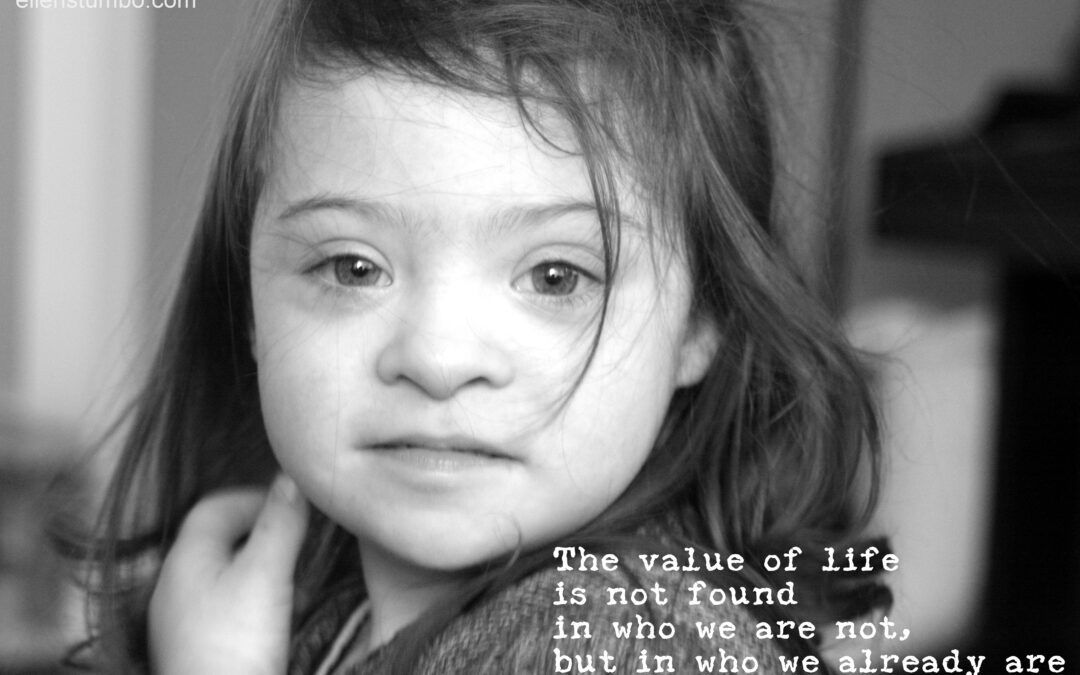
What if Nichole is not able to go to college? What if realistically her intellectual capabilities are not found in a classroom of higher education, even in programs targeted for others with intellectual disabilities? Will we have failed? Will she have failed? Will there be less value to her life?

She will never be a doctor, a lawyer, or a scientist. She will not be the greatest athlete or performer. She will not find the cure for cancer, and she will certainly not be the next president. But then I look at Nichole and I am trapped in her eyes, unable to look away, unable to question anymore. The little girl who looks back at me is not broken, and she is not less than perfect. The value of her life is not found in all the things that she will never be, but in the things that she is. And at only four years old, her accomplishments are those that many of us seek to achieve someday.

Down Syndrome Teacher

Nichole might not get to be a college graduate, but she is my teacher, my teacher of life. She has taught me what celebration looks and feels like. The power of cheering for others and the freedom of dance. She has taught me that a worthy performance is not found in a basketball court or a stage, but on a living room floor matching words and letters, and in saying simple broken sentences, ā€œCome back sit mom.ā€ I see it as she embraces hurting people, and her love brings them to tears. ā€œShe makes me feel loved like I never have been before,ā€ they say. I have seen worship to God that is so honest and seems so pleasing, that it moves me. I see it as Nichole tries to sing along at church, raising her arms to the God who gave her life, or singing along and dancing to a video while she tries to sing ā€œLet everything that breath sing praises to the Lord, praise the Lord!ā€ She has partnered with God to work in my selfish heart. A heart that many times is so lost in this world that it forgets that the standards I live for are not the ones set by people, but those set by God. She lives them, she teaches them to me.

Down Syndrome and Joy

I have seen joy in her and wished that I could feel what she feels. It is so pure. I have felt peace and love through her. At times when I am down, she instinctively knows it and comes to pat my back, and then she pulls me tight into a hug and offers a smile, maybe even asks if I need some crackers or chips too.

And every day she works harder than I do to master and accomplish new skills.

No diploma will ever be able to credit the value of Nichole’s life or the meaning of her accomplishments. She is already ahead of me in the things that really matter in life, and therefore she is my teacher and I her student.

And someday, maybe I will get to ā€œgraduateā€ and she will be the one cheering for me saying, ā€œYou did it mom! You did it!ā€ And I hope that she is as proud of me as I am proud of her now.

What Have You Learned from Your Child?

Okay, maybe a tissue warning should have been issued beforehand. Sorry about that! Now it’s your turn to tell us what you’ve learned from your child. Not just kids who live with Down syndrome, but all kids with special needs.

Do you like what you see at DifferentDream.com? You can receive more great content by subscribing to the quarterly Different Dream newsletter and signing up for the daily RSS feed delivered to your email inbox. You can sign up for the first in the pop-up box and the second at the bottom of this page.

By

Ellen Stumbo is a writer and speaker and the mother of three girls, two with disabilities. To read more of Ellen’s writing, visit her blog atĀ www.EllenStumbo.com.Ā  She can also be found onĀ TwitterĀ andĀ Facebook.

Author Jolene Philo

Archives

Categories

Subscribe for Updates from Jolene

Related Posts

Communication with My Daughter Who Has Down Syndrome

Communication with My Daughter Who Has Down Syndrome

Communication with My Daughter Who Has Down Syndrome

Communication with children who have special needs often requires creativity and flexibility. Today, guest blogger Ellen Stumbo describes the struggles and hopes she has with her daughter Nichole who lives with Down syndrome.

Just for a Day:
Communication with My Daughter Who Has Down Syndrome

by Ellen Stumbo

Just for a day, I wish my daughter with Down syndrome did not struggle with her speech. I know she gets frustrated when we don’t understand her, she tries as hard as she can to enunciate her words right, but sometimes, we still don’t understand what she is saying. She gets irritated, swings her little arms in desperation and yells at us. I don’t blame her, I would feel angry too.

Just for a day, I wish I could have a conversation with Nichole like I do with my other two daughters. I want to hear about her day at school, about what she likes and doesn’t like. I would ask her all about her favorite things, and I would spend the day talking, chatting, singing with her.

Just for a day, I wish Nichole’s speech was clear so that people would actually take the time to notice her, to enjoy her, and to listen to what she has to say.
Just for a day, I wish Nichole could speak her mind, all of it, good and bad. Non-stop chatter coming from her lips and straight into my ears.
Just for a day, I wish it was easy to communicate with my daughter.

She Has a Lot to Say

Nevertheless, Nichole does talk. Sure, her words and phrases might be hard to understand, but she has stories to tell us and things to say. The older she gets, the better her speech becomes, and I am confident that we will get there, that someday she will be talking so much we might even ask her to stop.

Things take Nichole a little bit longer, and it is easy to become impatient and take what we have now for granted. I love the fact that Nichole grabs my hand and shows me what she wants or needs. I love the fact that she is willing to repeat words after me. Her sweet voice is one of the loveliest sounds I have ever heard. I love her ā€œdaddyā€ call, and her laughter that comes from such an overflow of joy. I love how she surprises and amazes me with new words or new statements. And I know we will get there.

How Nicole Communicates

I love the way she signs, or the way she makes up signs. I smile thinking about the way she grabs my face to get my undivided attention, and to make sure I am listening to what she has to say.

I love the way she embraces people without caring what they look like or smell like. I have seen a grown man with tears in his eyes, as he expressed, ā€œShe makes me feel loved.ā€ And I realized that without words my daughter was able to communicate a love to this man he had never received. And suddenly I wish I could speak her language of unconditional love.

And her speech will not always be an issue, I will have conversations with my daughter, and not just for a day.

Your Communication Struggles and Hopes

Thank you, Ellen, for transparently sharing your dreams for Nicole.Ā You can also share dreams you have about communicating with your child in the comment box. Ellen and I would love to hear from you.

Do you like what you see at DifferentDream.com? You can receive more great content by subscribing to the quarterly Different Dream newsletter and signing up for the daily RSS feed delivered to your email inbox. You can sign up for the first in the pop-up box and the second at the bottom of this page.

By

Ellen Stumbo is a writer and speaker and the mother of three girls, two with disabilities. To read more of Ellen’s writing, visit her blog atĀ www.EllenStumbo.com.Ā  She can also be found onĀ TwitterĀ andĀ Facebook.

Author Jolene Philo

Archives

Categories

Subscribe for Updates from Jolene

Related Posts

Medical Bills Super Hero

Medical Bills Super Hero

Medical Bills Super Hero

Medical bills are a huge source of concern for parents of kids hospitalized because of their special needs. Sometimes, families sacrifice in very creative ways to pay for their kids’ treatment. A while back, my son-in-law Facebooked a link to an article about a dad who’s a medical bill superhero.

Who Is Our Superhero?

Our medical bill superhero is a Karl Kesel, the mild-mannered comic book writer who, according to an article at www.io9.com, “created the new Superboy character for DC in the 1990s.” Kesel and his wife Myrna adopted their son Isaac, who was addicted to heroin at birth. Little Isaac is now at home with his parents and doing well, but they have adoption bills and medical bills to pay.

How Is Our Superhero Paying the Medical Bills?

Kesel came up with a creative way to pay the medical bills. He’s put his valuable collection of comic books up for sale, hoping to raise $25,000 for adoption fees and $67,000 for medical bills, though insurance should cover most of that.

The article quotes Myrna, his wife. “It’s so touching to me that he’s willing to sacrifice something he loves so much to help us have a family. It’s a big deal, to let all those comics go.” The article goes on to say, “It’s a fair trade, Karl thinks. An investment in the miracle that continues to unfold, and the baby who screeches with delight each time his father sings to him.”

How Can We Help Our Superhero?

Even if you’re not a comic book geek (like my son-in-law who says the prices Kesel is asking are more than reasonable), you can still help our superhero. Please pass on Kesel’s story to the geeks you know and love. And be sure to send them to the link to the site where the comic books he’s selling to pay Isaac’s medical and adoption bills can be seen. (Link no longer active)

What Do You Think?

How does the story of Isaac’s superhero daddy make you feel? Leave a comment to share your thoughts.

Do you like what you see at DifferentDream.com? You can receive more great content by subscribing to the quarterly Different Dream newsletter and signing up for the daily RSS feed delivered to your email inbox. You can sign up for the first in the pop-up box and the second at the bottom of this page.

By

Jolene Philo is the author of several books for the caregiving community. She speaks at parenting and special needs conferences around the country. Sharing Love Abundantly with Special Needs Families: The 5 Love LanguagesĀ® for Parents Raising Children with Disabilities, which she co-authored with Dr. Gary Chapman, was released in August of 2019 and is available at local bookstores, their bookstore website, and Amazon. See Jane Dance!, the third book in the West River cozy mystery series, which features characters affected by disability, was released in October of 2023.

Author Jolene Philo

Archives

Categories

Subscribe for Updates from Jolene

Related Posts

Visual Impairment? What Cami Sees

Visual Impairment? What Cami Sees

Visual Impairment? What Cami Sees

Visual impairment is one of the special needs diagnoses Cami, daughter of guest bloggers Rudy and Rachel Corderio, lives with. Today, Rachel is back with a guest post about what her daughter sees beyond her visual impairment.

Beyond Visual Impairment: What Cami Sees


One question I have been asked numerous times is, ā€œWhat can Cami see?ā€

Whether people asked out of curiosity, fear, concern, sympathy, or their own need to be reassured, I would try my best to answer clearly. Yet with each answer, I grew more dissatisfied with what I said, bothered by something I couldn’t explain.

I rambled on about lights, colors, shapes, contrasts, and curbs, but found it difficult to express the uncertain.Ā  My answers were colored with illustrations and assumptions based on observations—with a hint of my own imagination.

Then, a thought hit me.Ā  After eight years of trying to determine and convey what CamiĀ  could or couldn’t see, I realized there was no need to guess.

Why?

Because I already knew.

She sees the wind when it blows through her hair, every strand caressing her face.
She sees the bird whose cheerful song greets her each morning while waiting for the school bus.
She sees the ice cream truck as its faint ā€œPop Goes the Weaselā€ music floats into the back yard where she plays.
She sees the tiny bumblebee whose loud buzzing causes her to run away in tears.

I now realize what had bothered me about my answer over the years—it wasn’t the truth. I had been so consumed with finding the right answer, I almost missed the obvious. In the midst of trying to decipher and define what my daughter could see, I was the one who couldn’t.

But now I do. And the next time I’m asked what Cami can see, I will answer confidently.

She sees everything. Just differently.

Who Is Visually Impaired?

This post makes me think about who is really visually impaired. Is it Cami? Or was it Rachel before she realized how much her daughter can see? Or is it those who ask about what she can see? Please share what you think in the comment box. I’d love to hear your perspective and Rachel would, too.

Do you like what you see at DifferentDream.com? You can receive more great content by subscribing to the quarterly Different Dream newsletter and signing up for the daily RSS feed delivered to your email inbox. You can sign up for the first in the pop-up box and the second at the bottom of this page.

By

Author Jolene Philo

Archives

Categories

Subscribe for Updates from Jolene

Related Posts

Advocacy 101: A Mom Became a Special Needs Advocate, Pt. 3

Advocacy 101: A Mom Became a Special Needs Advocate, Pt. 3

Advocacy 101: A Mom Became a Special Needs Advocate, Pt. 3

Advocate. Not the word that springs to mind when most young dads and moms describe their job as parents. But advocacy is a way of life for parents of kids with special needs. And in the past two days, Michelle Bartlett had given us a picture of life as a special needs advocate in Part 1 and Part 2 of the series, Advocacy 101. Today, Michelle is back to wrap up the series by sharing her best tips on where to find encouragement and how to become an effective advocate for your child.

Encouragement for Parents raising kids with Special Needs

My biggest word of encouragement is to try to treat your child as though her or she is more alike than different from other kids, and don’t forget to go into their world. It is easy to get lost in trying to make them meet all of those developmental milestones, but sometimes it is better to put that list away.

There are a lot of things I encourage families to be working on constantly. Understanding the stages of grief helps to understand how you react to certain situations. When the school would tell me everything my son could not do, I would go into denial mode since the school had no hope. In the grief stage of denial I was not realistic, but I was frustrated with them not seeing Jake. Our kids are just different, and being different is NOT a bad thing.Ā  It is all right to take a break and get a babysitter. Try to find friends with kids with disabilities so you have someone to talk with about the ups and downs. And most importantly never ever lose hope—God does miraculous things every day.

How Parents Can Become Effective Special Needs Advocates

  • Read as much as you can about your child’s diagnosis. At least every 6 months or so, do a search on his syndrome for new medical publications. Don’t be afraid to teach doctors about your child and the syndrome or medical condition. It is almost impossible to find a doctor who knows everything about every syndrome, and you know your child best.Ā  Each child is their own unique person and will not be exactly like another child with the same disorder. There will be similarities, but they will not be exactly alike.
  • Partner up with other families that have kids with special needs, take turns going to various conferences, and share the information with each other. Locate a support group to meet other families. Many families have time saving information to share.
  • Learn as much as you can about Special Education Law. It is also good to attend one another’s children’s IEP’s.Ā  Remember: You do not have to have a child with the exact same diagnosis to help one another.
  • If you are having issues at a hospital, find your Patient Support Representative to resolve the issues. Don’t be afraid to file a complaint. If you are at a military facility you have the right to a patient advocate.
  • When the law is getting ready to change, write your state representative. You are your child’s voice. We testified in Nebraska with Jake once and it was a great experience. With our testimony and others, a change was prevented in Medicaid waivers for a year.
  • Don’t forget to ask questions, ask questions, and ask questions.
  • If you feel like giving up, DON’T. We teach our kids to push hard to learn to walk, talk, and we can push hard just like they do.

Recommended Advocacy Resources

  • To start off, I love Jolene’s book, Different Dream Parenting, so I highly recommend that. (Jolene’s note: I did not ask Michelle to say that, but thanks, Michelle!)
  • Every family should own Wrights Law Special Education guide.
  • You can also access a lot of information about any medical condition online; just stick to .gov or .edu sites.
  • Ā Facebook is also a great way to find other families out there with kids with a similar diagnosis, or with kids with other types of disabilities. There are families out there that have been through similar experiences and can share with you how they dealt with certain situations.
  • When working with insurance companies make sure to highlight medical journals when you are appealing denials for equipment, supplies etc. It gives them a better idea of your child’s diagnosis.
  • A care notebook is also a very necessary tool, and super helpful to doctors/respite providers.
  • Again support groups, support groups, support groups.

How Churches, Schools, Friends, and Family Can Encourage and Advocate

We need people to LISTEN to us. Help us to help our children become valued members in our communities. We see them as valueable, and we want you to also. We are usually too busy to ask for help, but something as simple as holding a door open to us means the world. I also love it when my neighbor brings over food. One of the things that means the world to me is smiling at my child and not staring. I also do not mind questions, but please smile at him and acknowledge his existence.

What’s Your Best Advocacy Advice

Thank you, Michelle, for sharing the story of how you became Jake’s advocate. Now, peeps, it’s your turn to share how you advocate on behalf of your child. In the comment box, share your best advocacy tips.

Advocacy 101: A Mom Became a Special Needs Advocate, Part 1
Advocacy 101: A Mom Became a Special Needs Advocate, Part 2

Do you like what you see at DifferentDream.com? You can receive more great content by subscribing to the quarterly Different Dream newsletter and signing up for the daily RSS feed delivered to your email inbox. You can sign up for the first in the pop-up box and the second at the bottom of this page.

By

Author Jolene Philo

Archives

Categories

Subscribe for Updates from Jolene

Related Posts