
by jphilo | Apr 18, 2012 | Different Dream, School/Education, Special Needs Parenting
In yesterday’s post, guest blogger Kathy Guzzo described the unexpected special needs obstacles her daughter with medical special needs faced in college. She also described how she advocated on behalf of her daughter. Today, she provides several tips parents can use when advocating for children in primary and secondary school as well as in college.
Overcoming Special Needs Obstacles at College, Part 2
Respect + Persistence = Results
There were other situations that came up during her five years at the University, but with each one, we approached it by looking at what would be best for Andrea without trying to take advantage of or brow beat the administration. Once those involved understood the situation and the need, they were willing to do what they could. I had to remember that without living it, they wouldn’t ‘get it’ and our responsibility was to inform them so that in the future they would be more aware of the needs a student with a chronic illness may have.
This Is What I Now Know
The following are items I continually try to remember regarding the best way to ask for changes on behalf of a special needs child.
- Whether on the phone or in person always be respectful.
- Be prepared a list of your questions and or concerns written out to stay on topic.
- Have a notebook available to write down the name and date of anyone you talked with, names of numbers of those you may be referred to, as well as important information you are given.
- Be firm in the outcome you need, but flexible in developing a solution with those involved.
- Don’t get frazzled or frustrated if the first solution doesn’t work, be willing to try something else.
- Be persistent. Don’t give up.
Regardless of their age, parents are their child’s best, and sometimes only, advocate. Obviously as they get older they will handle some of the hurdles that come up on their own, but they need to always know that they have someone walking beside them, ready to step in whenever and however they may be needed.
What Can You Add to Kathy’s List?
Thank you, Kathy, for allowing us to benefit from your experience. What a great list! Perhaps you learned other strategies as you advocated for your child. If so, please leave a comment for the benefit of all.
Part One
Do you like what you see at DifferentDream.com? You can receive more great content by subscribing to the quarterly Different Dream newsletter and signing up for the daily RSS feed delivered to your email inbox. You can sign up for the first in the pop up box and the second at the bottom of this page.

by jphilo | Apr 17, 2012 | Different Dream, School/Education, Special Needs Parenting
Many parents worry about the special needs obstacles their children will face if they go to college. Guest blogger Kathy Guzzo found advocating for her daughter was an effective antidote to worry. In today’s post she explains what she learned about how to advocate in the college setting.
Overcoming Special Needs Obstacles at College, Part 1
As I look back on our daughter’s college years and all the struggles she had because of her chronic illness, I’m reminded of all the things I would’ve done differently if I knew then what I learned in the process. I don’t mean things that pertain to her health, but things that would’ve made her life easier as she dealt with her health issues. It’s true that hindsight is always 20/20.
I Didn’t Know What I Didn’t Know
Having had two older daughters that had gone to college, in fact at one time all three of them were in college, I felt I had a handle on what hurdles would come up. Such as not getting along with a roommate, books being unavailable, classes being mixed up, etc. but Andrea’s issues were different.
Dietary Obstacles
Because she is lactose intolerant and had some other dietary problems, the food in the cafeteria was the first thing we had to address. So we talked with the school dietician and she came up with a list of items Andrea was able to eat.
Housing Obstacles
Then, by the end of her first semester, we realized that because of her chronic fatigue and low immune system, she needed a single room so she could rest whenever necessary and to alleviate the risk of illness, not just from her roommate, but also from the community showers/bath. Since single rooms were considered for upper classmen, this took some convincing. However, we kept insisting and with the help of the Student Life Counselor she was in her new room before the second semester.
Medical Obstacles
We thought that would solve the issue but after repeated infections her doctors recommended that she live off campus, another ‘no-no’ for underclassmen. After talking with those in housing and again with the Student Life Counselor, getting the permission to move off campus wasn’t a struggle. What did become a problem was that she would lose a lot of her financial aid by not living on campus, which would add to our financial burden. I again spoke with the Financial Aid Department as well as the Dean and they agreed that if we could get a doctor to say she must live off campus for health reasons they would reinstate her housing allowance. So for the next 4 years she lived in an apartment off campus. I must admit I was nervous about her living alone 200 miles from home, but the health risks were to numerous to overlook.
Parking Obstacles
Another concern was parking. Her college was literally right on Lake Michigan which gets extremely cold and windy in the winter and the student parking lot quite a walk to any building. So once again, I found out whom to contact and I requested an exception asking that she be allowed to park in the visitor’s lot, which was much closer to an entrance. Once again, I had to be persistent, but they did agree and actually gave her a student handicapped sticker so she could park in a handicap spot because many times the visitor’s lot was full.
Educating Those Involved Is Critical
Surprisingly, the area that we had the most resistance in helping her was with a few of her professors who would get upset because she missed so many classes because of doctor’s appointments and illness, and not let her make up work. At one point a professor asked her for a doctor’s note which I thought was ridiculous. Again, I went to the Dean of Students explaining that we were paying for college and Andrea should not be punished because she was ill. After much discussion he agreed and sent email to all her professors giving the basics of her illness, that it was understood that she may miss several classes due to illness and appointments and she would be allowed to do make up assignments online and even turn them in late if necessary as long as all work was completed by the end of each semester.
What Special Needs Obstacles Have You Overcome?
What obstacles have your children faced in their education careers? How did you advocate for them? Leave a comment to share your experience and return tomorrow when Kathy shares her tips about how to be an effective advocate.
Part Two
Do you like what you see at DifferentDream.com? You can receive more great content by subscribing to the quarterly Different Dream newsletter and signing up for the daily RSS feed delivered to your email inbox. You can sign up for the first in the pop up box and the second at the bottom of this page.

by jphilo | Dec 15, 2011 | Different Dream, School/Education, Special Needs Parenting
Special education is a hot topic on YouTube these days, but finding the videos worth watching can be time consuming at best and futile at worst. So I am exceedingly thankful for special education graduate students assigned the task of compiling lists of worthwhile special education videos.
Enter Matt Holden
Matt Holden is one of those grad students (or at least I assume he is) who found www.DifferentDream.com and emailed the information about an article he recently wrote for the website www.mastersinspecialeductation.org. (Did you know such a website existed? I didn’t until Matt’s email.) The article is titled – you got it – 40 Must See YouTube Special Education Videos.
And the Categories Are…
- Introductory special education teaching methods
- Effective special education teaching methods
- Effective autism teaching methods
- Other effective special education teaching methods
- Special education teaching policies
Parents Can Watch the Special Education Videos, Too
The categories make it sound like the videos are for educators only. But they are an informative resource for parents, too. Some of them discuss IEP meetings, many explain special ed lingo, and some highlight resources you may want to recommend to your child’s teacher.But check it out for yourself at www.mastersinspecialeducation.org.
Which One is Your Fave?
After you watch some of them, come back and leave a comment about your faves. Why did you like them? What did you learn? What do you wish had been addressed?
Do you like what you see at DifferentDream.com? You can receive more great content by subscribing to the quarterly Different Dream newsletter and signing up for the daily RSS feed delivered to your email inbox. You can sign up for the first in the pop up box and the second at the bottom of this page.
by jphilo | Oct 28, 2011 | Different Dream, School/Education, Special Needs Parenting
The start of school can mean a break during the day while kids are at school. But it can also mean special needs homework battles every afternoon and evening during the week. Guest blogger, Rebekah Benimoff came up with a unique cease fire in the special needs homework wars at her house. See what you think.
Special Needs Homework War Cease Fire: Homework in a Bucket
The quietness of my day ended when the school nurse called me. Tyler’s blood glucose level was high– off the charts. Perhaps the “set” was kinked. (That’s insulin pump lingo.) We made it almost to the end of the school day, so that was a blessing!
The temperature in the mini-van reminded me of summer, and I contemplated the plan of action as I drove slowly through the school zone, along with the other parents arriving early. I reminded myself that Tyler would not die if I did not get to him in the next five minutes. “I WILL get to him, all in good time.” I repeated to myself. This is what my husband, a veteran chaplain, calls “self-talk”. Powerful tools for a worried mother. A reminder of the TRUTH of the matter.
I gathered up my gifts from God and we headed home– and for once, the chaos did not start in the car. Tyler was stuffing his face with the first food he’d been allowed in a whole two hours (due to slowly climbing BG levels after the post lunch BG check). Since he was on the way home to get new insulin, he could finally have a carb-free snack. Blaine was content to wave at the kids walking home, who were running in and out of the street like college students on Friday night. After the minivan came to a complete stop, the door opened and out tumbled my boys like two wrestling bear cubs. “Put your homework folders on the table!” I called as they headed willy-nilly through the door. And now, Homework Time begins. Ahh, the joy. Oh, the weeping and wailing. Earplugs anyone?
Special Needs Homework Challenges
Homework takes a lot of trouble shooting at our house. Tyler spent the last 45 minutes of the school day in the nurse’s office (20 of which were before she called me, so I must have made reasonable time, despite the “end of the school day” traffic). He rather luckily escaped having homework actually COME HOME, but there are still the weekly requirements of middle school, which Mom is now wise to. Like reading for twenty minutes. Once his BG leveled out, I still made him read. Despite how very unfair that is. Blaine, on the other hand, did have “real” homework. And homework is hard for Blaine… he can do the work, I just have to get him focused on DOING it. And finishing it. A couple years ago he was diagnosed with Sensory Integration Disorder, and we are still discovering all the little quirks; what works, what doesn’t. Sitting at the table and writing out the twelve spelling words of the week DOESN’T. Sitting on the couch and reading for 20 minutes doesn’t either. After an entire day of sitting at a desk, he wants to wiggle. He NEEDS to wiggle- even more than most little boys. Blaine has trouble with sitting upright or reasonably still for a long periods of time. He also struggles with writing legibly. Part of the “sensory issues”. Now that the light has come on, the knowledge helps this former Kindergarten teacher understand why my third grader has a hard time doing things my most of my younger students could do– by the end of that first year, at least! We have to get creative to help him do his very best work.
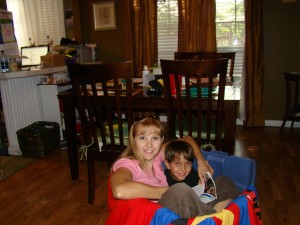
So, after a wiggle break, we did “Homework In The Bucket” — otherwise known as bucket therapy. But even after getting the bucket and choosing his blankets, pillows and books, Blaine was not settling INTO to the bucket. I was helping Tyler re-fill the tubes of insulin, and re-insert the insulin pump tubing into his poor little rear (via a rather large needle), and Blaine was trying to give the cat bucket therapy. Our furry family member was not impressed.
After some trauma to his heart and his bottom (he really dreads those shots), Tyler settled into reading his OWN books (which requires wading through fussing and complaining over how NOT FAIR homework is…whether BGs are off or not.) And I eventually coaxed Blaine into his Fort. He just would not settle. In and out of the bucket, in, and out. “I need another snack”, “I need another drink”, “I need my kitty…” (who did not want to go NEAR that bucket…)
The solution? Pictures speak a thousand words.
What’s Your Best Special Needs Homework Solution?
Rebekah climbed in a bucket to end her son’s homework war. No doubt you’ve discovered some unique homework solutions, too. If so, share your story in the comment box. Homework in a bucket. Homework standing on your head. Homework set to music.
Do you like what you see at DifferentDream.com? You can receive more great content by subscribing to the quarterly Different Dream newsletter and signing up for the daily RSS feed delivered to your email inbox. You can sign up for the first in the pop up box and the second at the bottom of this page.

by jphilo | Oct 3, 2011 | Different Dream, School/Education, Special Needs Parenting
Guest blogger Ellen Stumbo’s three girls went to school this fall. Each daughter responded differently to the experience, partly because of their personalities, partly because of their ages, and partly because back to school is different for kids with special needs. In today’s post Ellen writes about her thoughts about her girls’ first day of school and their untapped potential.
When Back to School Is Different for Kids with Special Needs
Another school year greets our family. It is the first time all my girls will be in school. They have clean, brand new backpacks, and their school supplies are neatly organized. They stand by the front door ready for me to snap a picture.
Ellie
Ellie is ready to conquer the world. The smile she wears and the hop in her step are evidence of her self-confidence. I see that, even in her picture.
Nina
Nina smiles, but I see the nervous way in which she holds on to her walker. Her knees seem a little unstable today. She has been to her school before. She has met her teacher, her aides and every single therapist that will work with her. We spent time in her classroom making sure that she could get around in her walker or wheelchair. She has a cute special chair for extra support when sitting at the table, and one for sitting on the floor. We made sure that the right adaptive equipment was available so she could use the bathroom as independently as possible. Yet, her picture reveals that despite all the help she will get, the challenges that her body and mind will face at school because of Cerebral Palsy are scary when you are only five years old.
Nicole
Nichole refuses to have her picture taken. She is angry. Angry that we have changed her routine. She does not want to go to school and demands to go inside the house again. She holds on to her cup of milk, her bowl of crackers, and the cover of one of her favorite shows while she cries in protest as we buckle her in the car. I wish she had the words to tell me how she feels. Even more than that, it makes me sad to think that she will not be able to tell me about her day when she returns home. If I could change one thing about how Down syndrome affects Nichole, it would be her speech.
Mommy
My husband Andy and I take the girls to school. As we walk out the door, I want to cry. I know many moms cry too, I get that. But this is different. Two of my children have special needs. The complexities of their schooling careers are hard even for me to understand at times. I hold on to their potential, and to the fact that just like their big sister, my 2 “special” children also will shine.
What Were Your First-Day-of-School Thoughts?
Were your feelings similar to Ellen’s on the first day of school a few weeks ago? What potential are you holding on to regarding your children? Leave a comment if you need to vent or are encouraged about the year.
Do you like what you see at DifferentDream.com? You can receive more great content by subscribing to the quarterly Different Dream newsletter and signing up for the daily RSS feed delivered to your email inbox. You can sign up for the first in the pop up box and the second at the bottom of this page.

by jphilo | Aug 24, 2011 | Different Dream, School/Education, Special Needs Parenting
Yesterday, you met Amy Dunaway. She’s a mom who’s become an expert in the area of special needs homeschooling. In the previous post, she introduced her family and told about how her blog www.onajoyfuljourney.com came about. In Part 2 of our interview, she encourages parents to persevere as they raise their kids with special needs. Read on!
What advice do you have for families just beginning their special needs parenting and special needs homeschooling journeys?
Embrace the journey! What might seem disappointing or even tragic brings many blessings and a deeper knowledge of the love and saving grace our Lord and Savior. It has been said that God will never give you more than you can handle. My journey has shown me that He does – only to increase my dependence on Him and my capacity to know and reflect His love.
What is the number one lesson you’ve learned as a parent?
His grace is sufficient. How comforting that is when dealing with teenage angst, a child with special needs or grieving the loss of a child! I’ve been many places on my parenting journey. Places where friends and family withdrew from us because of their own weaknesses. The Lord is always there with His gentle embrace, never abandoning His children.
What else would you like readers to know?
There is pain and suffering on this earthly journey. No one escapes it. I don’t want to minimize the pain and suffering along the way. There are tears to be cried and grief to be resolved. It feels messy and ugly…and filled with hard work. I have found that if I look at the trials I have faced as holy ground, sometimes so weak that I could only be carried through the day by His grace and love; His light would continue to reach me. Cling to hope and hope never dies.
Let others walk alongside you on your journey. Many will want to be supportive and we must guide them in their role. Many will not know what to do or say so they may not do or say anything. Teach them how to support and love your family and forgive them when they fail by showing them the same grace that blankets our own lives.
Your Turn Now
Are you feeling encouraged? Did you learn something from Amy’s journey? What have you learned from your journey? Now’s your chance to share lessons you’ve learned as a parent. I can’t wait to hear from you.
Part One
Do you like what you see at DifferentDream.com? You can receive more great content by subscribing to the quarterly Different Dream newsletter and signing up for the daily RSS feed delivered to your email inbox. You can sign up for the first in the pop up box and the second at the bottom of this page.