Using the 5 Love Languages to Help Traumatized Kids

Using the 5 Love Languages to Help Traumatized Kids

Using the 5 Love Languages to Help Traumatized Kids

Using the 5 love languages to help traumatized kids makes perfect sense to me. Not just because I’ve written extensively about childhood trauma and how to adapt the 5 love languages in special needs families. But because I’m the parent of a son affected by trauma and a former educator who witnessed the positive impact loving adults can make in a child’s life.

The love languages are a simple tool that parents, teachers, day care providers, pastors, medical professionals, therapists, and other adults in children’s lives can use to amplify that impact. This is true whether a child’s trauma is caused by abuse, removal to foster care, divorce, natural disasters, accidents, the death of a loved one, painful and invasive medical or dental procedures, homelessness, or other overwhelming events. Here’s why I believe using the 5 love languages to help traumatized kids is worthwhile.

The love languages help children feel safe. Traumatic events decrease a child’s feeling of security and safety. After the traumatic event, they need assurance that they are loved and safe. When those assurances are delivered in the child’s primary love language, the child will be more receptive to them. The love languages enhance communication. Children affected by trauma require frequent reminders that they are safe over a long period of time. The more trauma they’ve experienced, the more reminders they need. By speaking a child’s love language to deliver that reassurance in a variety of creative ways, they are more likely to hear and accept it.

To read the rest of Using the 5 Love Languages to Help Traumatized Kids, visit the Hope Anew blog.

Do you like what you see at DifferentDream.com? You can receive more great content by subscribing to the monthly Different Dream newsletter and signing up for the daily RSS feed delivered to your email inbox. You can sign up for the first in the pop up box and the second at the bottom of this page.

By

Jolene Philo is the author of theĀ Different DreamĀ series for parents of kids with special needs. She speaks at parenting and special needs conferences around the country. She’s also the creator and host of theĀ Different Dream website.Ā Sharing Love Abundantly With Special Needs Families: The 5 Love LanguagesĀ® for Parents RaisingĀ Children with Disabilities, which she co-authored with Dr. Gary Chapman, was released in August of 2019 and is available at local bookstores, their bookstore website, andĀ at Amazon.

Author Jolene Philo

Archives

Categories

Related Posts

Educators Care about Traumatized Kids

Educators Care about Traumatized Kids

Educators Care about Traumatized Kids

Educators care about traumatized kids. I came to this conclusion after facilitating professional development classes for more than 80 Iowa classroom and special education teachers, substitutes, paraprofessionals, and administrators this past summer. Whether they work with children in birth to 3 programs, in preschool programs, from kindergarteners to high school seniors, educators care about traumatized kids. Ā While working with 4 different groups, these educators exhibited a number of similar characteristics that led to this conclusion. I’d like to share them with you now.
Educators do work in the summer.Ā Many of them without pay. Plus, most of them pay for classes out of their own pockets. (Few other professions require their workers to pay for license renewal hours.) For 1 license renewal credit, educators are required to put in 2 full days plus homework. They signed away 2 days gorgeous summer days for this particular class, An Educator’s Guide to PTSD in Children, because they feel ill-equipped to meet the needs of the traumatized kids in their schools. They want to do better.

EducatorsĀ can’t know what they don’t know.Ā TheyĀ don’t receive trauma training in college and can’t be faulted for not knowing what they don’t know. Instead they should be applauded for devoting 2 full days of summer vacation to filling in this knowledge gap. By the end of the second day of class, when their brains feel like mush after absorbing and processing a great deal of new learning, much of it from Does My Child Have PTSD? What To Do When Your Child Is Hurting from the Inside Out, they are eager to apply what they know when a new school year begins.

Educators are creative and practical. Every person who takesĀ the class has to develop an action plan describing 3 strategies they will implement to make traumatized children feel safer at school. From school administrators to paraprofessionals, from elementary to secondary teachers, the creativity of their action plans blows me away time after time. Not only are the strategies appropriate for the developmental levels of their students and in line with their positions, they are practical and doable. Which means the strategies are much more likely to be implemented and maintained.

Educators go the extra mile. While their action plans are creative and practical, the strategies they select require extra effort. In addition to taking the class on their own time and dime, educators spend extra time putting their strategies in place. They also spend their own money on needed supplies. Like markers and stress balls for a quiet corner in the classroom. Or snacks for kids who come to school hungry.

Educators care about traumatized kids.Ā A strategy many teachers and paraprofessionals choose is to talk to their district administrators about providing more trauma training in schools. Many administrators who take the class include developing more trauma training for the teachers in their action plans. Why? Because all these these educators care about traumatized kids. Once they know more about how to make a difference in their students’ lives, they want to teach their colleagues about it.

After all, they’re teachers, and they love doing what they do best. They love to teach.

Do you like what you see at DifferentDream.com? You can receive more great content by subscribing to the monthly Different Dream newsletter and signing up for the daily RSS feed delivered to your email inbox. You can sign up at the bottom of this page.

By

Jolene Philo is a published author, speaker, wife, and mother of a son with special needs.

Author Jolene Philo

Archives

Categories

Subscribe for Updates from Jolene

Related Posts

The ACEs and Toxic Stress: Implications for Children with Special Needs?

The ACEs and Toxic Stress: Implications for Children with Special Needs?

The ACEs and Toxic Stress: Implications for Children with Special Needs?

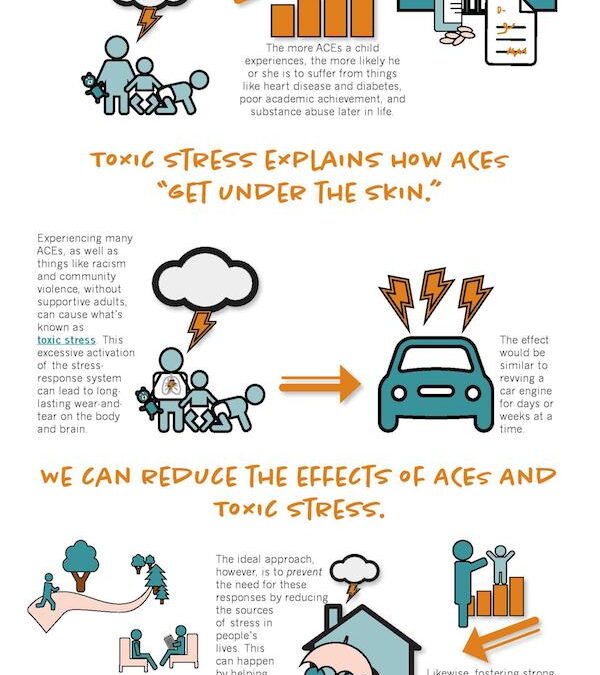
The link between theĀ ACEsĀ and toxic stress have been accepted by mental health experts since the ACEs study results were released in the late 1990s. The general public and members of the special needs community, however, are not equally aware of the study and its implications for children.Ā The Harvard Center for the Developing ChildĀ recently created an infographic that explains the link clearly and thoroughly. The infographic can be found below. It is also available atĀ The Center for the Developing Child website. Their web page includes a FAQ section, and the infographic can be downloaded as a PDF there.

My sonĀ endured numerous invasive surgeries and procedures in his early years to correct a life-threatening birth anomaly. Based on that experience, I believe the link between the ACEs and toxic stress has many implications for children who undergo invasive medical procedures, live with pain, or experience discrimination or bullying due to special needs. I encourage you to study the infographic, visitĀ The Developing ChildĀ website, or readĀ Does My Child Have PTSD: What To Do When Your Child Is Hurting from the Inside Out?Ā to learn more.


Do you like what you see at DifferentDream.com? You can receive more great content by subscribing to the quarterly Different Dream newsletter and signing up for the daily RSS feed delivered to your email inbox. You can sign up for the first in the pop up box and the second at the bottom of this page.

By

Jolene Philo is a published author, speaker, wife, and mother of a son with special needs.

Author Jolene Philo

Archives

Categories

Subscribe for Updates from Jolene

Related Posts

My 4 Greatest EA/TEF Mom Fears

My 4 Greatest EA/TEF Mom Fears

My 4 Greatest EA/TEF Mom Fears

EA/TEF Mom fears are on today’s EA/TEF Awareness Month menu. They’re being served up by guest blogger, Jill Seaney whose little boy is now three. In today’s post she describes her top four EA/TEF Mom fears. Her worries will be all to familiar to other EA/TEF parents and perhaps unbelievable to those just learning about the condition.

My 4 Greatest EA/TEF Mom Fears

Being a parent can be scary! Parents worry about things like babies sleeping through the night, toddlers eating their veggies, or how their child will do in school. These are all real and valid worries.

But what if your child was born with complex medical problems? My son, Blake, who is now 3.5 years old, was born with multiple birth defects, the most serious of them at birth was esophageal atresia and a tracheoesophageal fistula (EA/TEF) which required major repair surgery when he was 3 days old. He is now ā€œfixedā€ in the sense that his surgery was successfully completed— his esophagus was connected to his stomach and his trachea and esophagus were separated. However, he will never be ā€œcuredā€ and will have struggles related to this birth defect for the rest of his life.Ā Below are my four biggest EA/TEF Mom fears.

  1. The common cold or flu manifesting into something much worse. All kids born with EA/TEF have a medical condition called tracheomalacia (TM), a collapse of the airway when breathing. When a person with TM exhales, the airway collapses partially or even all the way in really severe cases. The airway is floppy and it makes it much more difficult to have a productive cough that gets bacteria and junk up and out of the airway. Instead, it sits in the airway and can turn into a bad respiratory infection, often times pneumonia. A child with aĀ common cold is usually better within 10 days. For a child born with EA/TEF the common cold can quickly and easily turn into a hospitalization for pneumonia. As soon as the weather starts cooling down, usually right after the holidays here in Arizona, we go into ā€œhibernation modeā€ in order to prevent sickness as much as possible.
  2. Eating. Especially in public.Ā Most kids born with EA/TEF have a narrower than normal esophagus due to connection surgery at birth. Often times, food gets stuck in the narrow part of the esophagus. The only way to unclog the esophagus is to get the food to go down to the stomach or get it to come back up (vomiting). As my son gets older we can get the food unstuck by giving him soda or pineapple juice. But typically he vomits more quickly than normal to bring it back up. He turns reddish-blue and makes a loud noise as the food comes back up and out his mouth. When we eat in public I cut his food into teeny, tiny bites and tell him to chew, chew, chew. I also encourage small sips of soda to prevent what EA/TEF parents call ā€œstuckiesā€. The stares from bystanders are tough some days, but mostly I worry about how children eating at the table with him will respond in a couple years when he goes to school. I worry about his heart being broken if kids make fun of him.
  3. Damage to the esophagus from reflux and long term effects of medications taken for reducing acid. Most people with EA/TEF have acid reflux. BlakeĀ has been on high doses of two acid reflux meds since birth. His doctor saysĀ the reflux will not likely ever go away. All we can do is keep medicating him to reduce the amounts of acid so it doesn’t do as much esophageal damage when he does reflux. Reflux is awful to watch. Blake refluxes the worst when he laughs or cries too hard, or when he falls asleep and is totally relaxed. I have to tell my 3-year-old is to calm down when he starts having too much fun. I know that he is likely going to reflux, and stomach contents will shoot up and out his mouth and nose. It will end with him crying because it hurts so badly. I fear social settings with other young kids when he gets excited or laughs too hard. What if reflux shoots out his mouth and nose in front of them? We keep him on high doses of medications to reduce acid in the stomach to protect his esophagus. But at the same time, I worry about long term side affects from the medications.
  4. Ongoing narrowing of the esophagus and esophageal dilations. Kids who are born with EA/TEF often times have stricturing (narrowing) of the esophagus. The narrowing can get so tight a dilation’s needed to open the esophagus so foodĀ can go down without getting clogged up. The dilation is done under anesthesia. The surgeon inserts a deflated balloon into the esophagus and then inflates the balloon to lightly push open the stricture again. The dilation can work for years but might have to be repeated throughout childhood and into adult life. My son has had four dilations so far. It’s hard to watch him go through dilation after dilation. WhenĀ food starts getting stuck more frequently, my worry and fear is that the stricture is narrowing and will need another dilation. We also worry about an esophageal perforation or other complication with more dilations and manipulations. Our son hasĀ to be intubated to protect his floppy airway which one time resulted in a paralyzed vocal chord. That makes him more susceptible to food aspirations and aspiration pneumonia now.

Like all moms, I worry about normal stuff. But IĀ have an extra long list of out-of-the-ordinary fears and worries as well. I hope these examples help other EA/TEF parents know that they are not alone in these fears. I hope they shed some light about typical fears of an EA/TEF parent to those unfamiliar with the condition before the start of Awareness Month!

Do you like what you see at DifferentDream.com? You can receive more great content by subscribing to the quarterly Different Dream newsletter and signing up for the daily RSS feed delivered to your email inbox. You can sign up for the first in the pop up box and the second at the bottom of this page.

By

Jill lives in Tucson, AZ with her husband Jeff and their son Blake. She worked in Human Resources up until 2014 when her son was born with VACTERL Syndrome which included EA/TEF. Jill resigned to care for her son full time. Later he was also diagnosed with a Congenital Diaphragmatic Hernia and Eosinophilic Esophagitis. Jill’s personal blog (Beloved Blake) documents his surgeries and health challenges, their family struggles, and Blake’s milestones. Jill loves writing and teaching others about what it’s like raising a child with complex medical needs. She wants to be a blessing to other parents just starting on this journey.

Author Jolene Philo

Archives

Categories

Subscribe for Updates from Jolene

Related Posts

How Parents Can Advocate Effectively for Traumatized Children

How Parents Can Advocate Effectively for Traumatized Children

How Parents Can Advocate Effectively for Traumatized Children

This article is the eleventh in a series about PTSD in children. Previously, children have been the focus of each post. In this article and the next, the parents of traumatized children will be front and center. Why? Because children with PTSD can’t advocate for themselves. They need us to be their voice when they are too small and too broken to advocate on their own behalf. This post discusses three skills parents must cultivate to be effective advocates for traumatized kids.

How to Become an Organized Advocate for Traumatized Children

Parenting children with unresolved trauma can be a challenge at home. And because their worlds extend beyond their family circles they can encounter trauma triggers at school, athletic events, church, and in the community that send them into a behavioral tailspin. Therefore, parents must become effective advocates in all those places. To do so they must be organized.

Advocacy generates a mountain of information and paperwork. Here are a few simple ways to make that mountain scalable.

  • Use a spiral or composition notebook to write down questions and log observations about how your child responds to triggers and stressful situations and to track behavior patterns at home, school, and social events. Take the notebook with you to all medical appointments, therapy sessions, and school meetings. With your observations in good order, you will be able to add to any discussion.
  • Use a three-ring binder and file folder system for hard copies of paperwork related to your child’s school career, therapies, and medical interventions.
  • Create and label electronic folders for emails and documents if you prefer computerized records. You can also use Google Docs to create your own forms and integrated calendars and schedules.
  • Use your smartphone to take pictures of hard copy forms or calendars that you use for scheduling and email them to yourself. Then create email folders for storing them.

To read the rest of this post, please visit Key Ministry’s blog, Church4EveryChild.

Part 1: Writing About PTSD Was Not on My Bucket List
Part 2: Childhood Trauma by Any Other Name Is Still Traumatic
Part 3: 10 Myths about PTSD in Children
Part 4: What Causes PTSD in Children
Part 5: A Look Inside the Brain’s Response to Childhood Trauma
Part 6: Why the Spotlight Is on PTSD in Children
Part 7: Childhood PTSD Symptoms in Tots, Teens, and In Between
Part 8: Why and How Childhood PTSD Is often Misdiagnosed
Part 9: Effective Treatment of PTSD in Children
Part 10: How to Prevent PTSD in Traumatized Children
Part 11: How Parents Can Advocate Effectively for Traumatized Children
Part 12: 4 Reasons Traumatized Kids Need Mentally Healthy Parents
Part 13: Clinging to Faith While Parenting Children with PTSD

Do you like what you see at DifferentDream.com? You can receive more great content by subscribing to the quarterly Different Dream newsletter and signing up for the daily RSS feed delivered to your email inbox. You can sign up for the first in the pop up box and the second at the bottom of this page.


By

Jolene Philo is the author of theĀ Different DreamĀ series for parents of kids with special needs. She speaks at parenting and special needs conferences around the country. She’s also the creator and host of theĀ Different Dream website.Ā Sharing Love Abundantly With Special Needs Families: The 5 Love LanguagesĀ® for Parents RaisingĀ Children with Disabilities, which she co-authored with Dr. Gary Chapman, was released in August of 2019 and is available at local bookstores, their bookstore website, andĀ at Amazon.

Author Jolene Philo

Archives

Categories

Subscribe for Updates from Jolene

Related Posts

4 Childhood Trauma and PTSD Updates

4 Childhood Trauma and PTSD Updates

4 Childhood Trauma and PTSD Updates

Childhood trauma and PTSD have been in the news frequently of late. That’s good news after years of trying to raise awareness about this form of mental illness. For this author, whose book about childhood trauma and PTSD will be released later in 2015, it’s good news indeed. It’s even better news for parents raising traumatized children. This post highlights four advances in the field that have been in the news during the past several months.

Anxiety Disorders, Childhood Trauma, and PTSD

Anxiety disorders are often closely tied to childhood trauma and PTSD. This article at Mom Junction describes 5 types of childhood anxiety. Then, it offers 9 practical ways to deal with anxiety issues in kids. If your child’s trauma is manifested by anxiety, you will want to read 5 Types and 9 Ways to Deal with Anxiety in your Kid.

How Teachers Can Help Kids Impacted by Childhood Trauma and PTSD

Next up is a short article at The Atlantic’s website. The article suggests five strategies teachers can use to support traumatized children. Why do teachers need to know these strategies? Because, the article says, 1/4 of students have experienced a traumatic event. So you might want to check out How Teachers Help Students Who’ve Survived Trauma and then pass it on to your child’s teacher. Even if your children haven’t been traumatized, many of their classmates are.

Childhood Trauma and PTSD Impacts More than One in Four Kids

If you find it hard to believe that 1 in 4 children are impacted by childhood trauma and PTSD, then prepare yourself for an even bigger shock. New research conducted by the Johns Hopkins Bloomberg School of Public Health in Baltimore finds that almost half of children in the United States suffer from traumatic stress. Still skeptical? Then read this Health Day press release to get the whole story.

Preventing Childhood Trauma and PTSD in Medically Fragile Children

And finally, a new program at Children’s Hospital of Orange County is being used to prevent or reduce childhood trauma and PTSD in hospitalized children. The hospital has built an Infusionarium. One wall of the Infusionarium, where kids play video games and check their social media accounts while receiving chemo or other infusions, is a huge aquarium. To get the whole story, A Hub for Social Media and Video Games Can Reduce PTSD in Kids Enduring Chemo Treatment, explains the Infusionarium very well.

Other Childhood Trauma and PTSD News?

Have you read other stories about childhood trauma and PTSD lately? Heard about some breakthroughs? Please tell about them in the comment box. Thanks!

Do you like what you see at DifferentDream.com? You can receive more great content by subscribing to the quarterly Different Dream newsletter and signing up for the daily RSS feed delivered to your email inbox. You can sign up for the first in the pop up box and the second at the bottom of this page.

By

Jolene Philo is the author of theĀ Different DreamĀ series for parents of kids with special needs. She speaks at parenting and special needs conferences around the country. She’s also the creator and host of theĀ Different Dream website.Ā Sharing Love Abundantly With Special Needs Families: The 5 Love LanguagesĀ® for Parents RaisingĀ Children with Disabilities, which she co-authored with Dr. Gary Chapman, was released in August of 2019 and is available at local bookstores, their bookstore website, andĀ at Amazon.

Author Jolene Philo

Archives

Categories

Subscribe for Updates from Jolene

Related Posts