Unexpected Traditions and the True Meaning of Christmas

Unexpected Traditions and the True Meaning of Christmas

Unexpected Traditions and the True Meaning of Christmas

A year ago, my left hand was in a cast to recover from surgery to reconnect the thumb tendon I’d severed in a kitchen accident. A back injury had incapacitated my man-of-steel husband. As a result, we wisely decided to forego decorating the house for Christmas. “It’s only for one year,” we told each other. “We’ll do things up right next year.”

Those were, dear readers, our most Famous. Last. Words.

A month ago, we stumbled upon a house that satisfied every condition on our someday-we’d-like-to-downsize-and-live-in-a-house-with-the-following-features list, and we bought it. We’ll be moving sometime during the holidays, and our Christmas decorations are too big and too numerous for the new home. So we donated our tree and half our decorations to Good Will. And we decided not to decorate for the holidays for the second year in a row.

That, dear friends, is how unexpected holiday traditions begin at our house.

Parents of kids with special needs are all too familiar with holiday traditions of the unexpected kind. We know too much about canceling holiday plans because a medically fragile child spikes a fever, changing travel routes from Grandma’s house to the hospital for emergency Christmas surgery, or arriving late for family gatherings and leaving early to lessen the likelihood of meltdowns in kids who are sensory sensitive.

That, dear parents, is how unexpected holiday traditions begin families like ours.

Two thousand years ago, an unexpected tradition began one starry night when a young woman gave birth to the Son of God, assisted only by her husband.

To read the rest of this post, visit Key Ministry’s blog for parents of kids with special needs.

Do you like what you see at DifferentDream.com? You can receive more great content by subscribing to the quarterly Different Dream newsletter and signing up for the daily RSS feed delivered to your email inbox. You can sign up for the first in the pop up box and the second at the bottom of this page.

By

Jolene Philo is the author of the Different Dream series for parents of kids with special needs. She speaks at parenting and special needs conferences around the country. She’s also the creator and host of the Different Dream website. Sharing Love Abundantly With Special Needs Families: The 5 Love Languages® for Parents Raising Children with Disabilities, which she co-authored with Dr. Gary Chapman, was released in August of 2019 and is available at local bookstores, their bookstore website, and at Amazon.

Author Jolene Philo

To get posts delivered to your inbox, enter your email address:

Delivered by FeedBurner

Archives

Categories

Related Posts

Loved Beyond All Measure

Loved Beyond All Measure

Loved Beyond All Measure

Loved beyond all measure. That’s how guest blogger Stephanie Ballard felt about the dolls she received each Christmas. Much as she loved them, caring for those childhood dolls didn’t prepare her for the challenges of caring for her son with special needs. Neither did it prepare her for the fierce love she has for him.

Loved Beyond All Measure

So many Christmases ago
When I was little too,
I’d wait so ever patiently
My turn would come, I knew.
The presents were ripped open–
The best was saved for last.

A doll, my doll!  Yes, every year,
The same as each year past.
We’d go into our playroom,
(We dressed our babies there.)
And play a game that we called house.
What will my baby wear?

Baby Alive came one year.
I’d mix up that slimy green goo.
Baby Alive always opened her mouth
And happily swallow and chew.
No feeding tube to contend with.
No pump to beep, “All done.”
A spoon held to her willing mouth
Wow, feeding time was fun!

Baby Soft Sounds came the next year.
She cried when not held tight.
Luckily, I could still sleep
Since Mom turned her off each night.
No wires left me powerless
To hold my child near.
No doctors rounded daily.
I had nothing to fear.

Next came Baby All Better,
With thermometer, to play.
Just a little cool water
And her fever went away.
No countless calls to the hospital
No trips to the ER.
A splash of water–all was well!
No need to drive so far.

Rarely did our games include
Our babies getting sick
But if and when this did occur
A shot would do the trick.
Out came the Fisher Price medical kit.
It had all of the tools we needed
To take all the owies away.
Motherhood was easy.
It ended for the night
By tucking our sweet babies in,
Then kissing them goodnight.

Perhaps life just isn’t that easy
And childhood dreams go unfulfilled,
Locked away for a season,
Then refound in the eyes of my child.
No, this isn’t the life I imagined
While rocking my doll with a smile.

I never imagined that being a mom,
Could come with a heart-wrenching trial.
But, I am thankful for this child.
He truly is a treasure.
I am the mom of a special needs child
Who is loved beyond all measure.

~Stephanie Ballard

Do you like what you see at DifferentDream.com? You can receive more great content by subscribing to the quarterly Different Dream newsletter and signing up for the daily RSS feed delivered to your email inbox. You can sign up for the first in the pop up box and the second at the bottom of this page.

By

Stephanie Ballard is the mother of two sons, her youngest son, Braeden, was born with Kabuki Syndrome and congenital heart defects. Her oldest son, Colin is in the military. She enjoys writing poetry and life lessons about her journey in life.

Author Jolene Philo

To get posts delivered to your inbox, enter your email address:

Delivered by FeedBurner

Archives

Categories

Related Posts

He Has Come: When the Divine Meets Diagnosis

He Has Come: When the Divine Meets Diagnosis

He Has Come: When the Divine Meets Diagnosis

Guest blogger Kimberly Drew and her husband found their faith tested when their new daughter received a life-changing diagnosis. In this post, she explains how her struggles during this Christmas season led her to a place of rest.

He Has Come: When the Divine Meets Diagnosis

I’m sitting across from a beautiful neurologist. She’s trying her very best to deliver difficult news. I hear her say, “I believe we are headed in the direction of cerebral palsy.”

I smile and tell her something like, “It’s okay. That’s what we were expecting,” that I wasn’t surprised.

My parents are with us for the visit, and I can feel the mood in the room change, so I quickly started assuring everyone, “I’m okay. It will be okay.”

It’s amazing how fast I can change gears from being parent to daughter to wife. A quiet hand squeeze in the elevator between my husband and I and that was that.

I slept like a baby that night and didn’t give it a second thought. I told a few people about how the visit went and thought all was well in my soul. Then I found myself in a staff meeting at the Christian school where I teach. During prayer requests, I decide to mention it.

That’s when the wall goes down. I’m in tears and trying very hard to pull it together.
I do my best to process, but when the day closes I find myself in absolute hysterics. I turn up the music and water in the bathroom so no one will hear me crying. But at a certain point, I realize that if I don’t stop crying I might actually be sick.

Time to go to bed. I lie there and the questions start rolling. What if I can’t do this again? What if my marriage can’t handle two children with special needs? What if I get depressed or my anxiety comes back? What if I gain more weight trying to cope with the stress of doctors and insurance and the unknowns? What if, what if, what if…

I think that questions will continue to roll in, and only time will quiet my fears. In these moments I feel so far from where I need to be as a human being, and I have so much to learn. A quiet thought settles my spirit. I think of how the answer to every fear and question can be discovered in one simple phrase. He has come.

In Luke 1:68 Zechariah prophesies the birth of Christ, “Praise be to the Lord, the God of Israel, because He has come to his people and redeemed them.”

In the Christmas season, we remember and celebrate the birth of Christ. We remember and celebrate that He has come to his people and redeemed them. He has come…He has come for me. He has come to redeem, and what He redeems heaven will restore.

I will will find rest in that. I choose to find rest in that. When the “what ifs” try to steal my joy and rob me of moments that I can never get back, I will repeat the words He has come to myself. I’ll do my best to pursue the One who came as an infant King in a dirty wooden manger all the way to a bloody wooden cross in order to pursue me. And when I can’t understand, or process, or breathe, I’ll remember that Christ has come.

Friend, if you’re reading this you probably know exactly how I feel. I just want you to know that I understand. What you’re feeling is real, and validated, and so very hard. But I hope you will take a minute to think about the fact that Christ came for you. Out of a desperate love and desire to see you redeemed, he came for you.


Do you like what you see at DifferentDream.com? You can receive more great content by subscribing to the monthly Different Dream newsletter and signing up for the daily RSS feed delivered to your email.

By

Kimberly grew up and went to college in the small town of Upland, IN. She graduated from Taylor University with a degree in Elementary Education in 2002. While at TU, she married her college sweetheart and so began their adventure! Ryan and Kimberly have four amazing kids on earth (Abigail, Jayden, Ellie, and Cooper), and a baby boy waiting for them in heaven. Their daughter Abigail (Abbey) has multiple disabilities including cerebral palsy, a seizure disorder, hearing loss, microcephaly, and oral dysphagia. She is the inspiration behind Kimberly’s  desire to write. In addition to being a stay at home mom, Kimberly has been serving alongside her husband in full time youth ministry for almost fourteen years. She enjoys working with the senior high girls, scrapbooking, reading, and music. You can visit Kimberly at her website, Promises and Perspective.

Author Jolene Philo

To get posts delivered to your inbox, enter your email address:

Delivered by FeedBurner

Archives

Categories

Related Posts

Disability Etiquette: What to Say and What Not to Say

Disability Etiquette: What to Say and What Not to Say

Disability Etiquette: What to Say and What Not to Say

Compassionate disability etiquette is a gift parents of kids with special needs love to receive. Today Different Dream guest blogger Trish Shaeffer is here to share what she’s learned about disability etiquette as mom to 1 typical child as well as twins with special needs. Read on to learn how to give the gift of disability etiquette during the Christmas season.

Disability Etiquette: What to Say and What Not to Say

Comments made by other adults often catch parents of children with disabilities off guard. Inappropriate words bring up many emotions, and parents find it really hard to have a reply to them. Language is a powerful tool that can cause great harm if used unwisely. Generally, people aren’t unfeeling. Rather they are unthinking. They need to be challenged to approach children’s disabilities in a more positive and sensitive way. Below are several negative comments followed by positive ones that are examples of disability etiquette.

Disability Etiquette: What Not to Say
  1. I’m sorry to hear that. Having a child with a disability should not be viewed as a disappointment or loss that requires an apology.
  2. What’s wrong your child? There is nothing wrong.
  3. Poor little thing. Parents want their child empowered, not pitied.
  4. Have you tried__________________? The chances of you knowing more about the disability than a parent are slim. They probably have exhausted every treatment out there.
  5. But your child doesn’t look sick. Many children with special needs are not sick. They have lifelong developmental disorders like autism, which are not an illness.
  6. Your child makes me realize how lucky I am. Those words suggests that the child and parent are unlucky.
  7. I don’t know how you cope. Nor do we. But our children are our priority. If society was more aware of how difficult parenting a child with disabilities can be, there might be more accessible help available.
  8. At least your other children are okay? What makes a child okay? The fact that they can talk? Or have full range of movement? Many disabled children are far better at communicating and being mobile then most neuro-typical children.
  9. Is it a degenerative condition? Some children who have disabilities have a shorter life span. But the constant reminder is at best unhelpful, and the worst unkind.
  10. So your child gets out and about then? People with disabilities like and enjoy many of the same things all people do.
  11. Is it genetic? Only family members have the right to ask this question.
  12. Your child grow out of it, right? Most do not outgrow disabilities such as cerebral palsy.
  13. Did you cause your child to be in a wheelchair? What would possess someone to ask this?
  14. Wow, you must be busy! This comment comes across as condescending to parents doing what they must to survive.
  15. Did you do drugs or smoke during pregnancy? This question simply shouldn’t be asked.
  16. You’re overreacting! or If you would only spank your child! These statements suggest the parent is ignorant, stupid, lazy or incompetent.
  17. You should be glad it’s not worse! or You shouldn’t feel like that.  These statements mean “I don’t want to be bothered with your problems.”
  18. Is your child retarded?  Never use the R word! It’s rude and incorrect language to use to describe a child with learning disabilities or a developmental delay.
Disability Etiquette: What to Say
  1. Wow, I didn’t realize that. Your child looks amazing. You must be so proud.
  2. You must have worked really hard because your child is amazing.
  3. What caused your child’s challenges?
  4. How is your child doing? What’s being worked on in therapy this week?
  5. What are your child’s hobbies?
  6. I like your child’s braces.
  7. You’re such a great caregiver.
  8. How are you holding up?
  9. I like that wheelchair.
  10. How can I help?
  11. What kinds of therapy does your child enjoy?
  12. Did your child have fun at school?
  13. Your child has a beautiful smile.
  14. My little boy likes trucks, too.
  15. That’s tough.
  16. Do you need help getting the wheelchair into your car? Do you need help carrying your groceries out?
  17. Wow! I cant believe how far your child has come.
  18. Your child is so good at ____________________.
  19. Your child really loves you.
  20. Your child has taught me so much.
  21. I brought wine! I had to add that. Couldn’t help myself.
  22. I think your kid is great!
  23. Your child is lucky to have you as a parent.
  24. I don’t know much about your child’s condition. Can you suggest some reading for me to educate myself?
  25. You are so patient.

Do you see a trend? Negative responses can be turned into positive and helpful ones. Remember, parents may react differently, so pick a good time to bring something positive. Look past the disability and and treat the child like a child. Too often parents of kids with special needs experience negativity. They need a positive lift. You have the power to make their day.

Do you like what you see at DifferentDream.com? You can receive more great content by subscribing to the quarterly Different Dream newsletter and signing up for the daily RSS feed delivered to your email inbox. You can sign up for the first in the pop up box and the second at the bottom of this page.

By

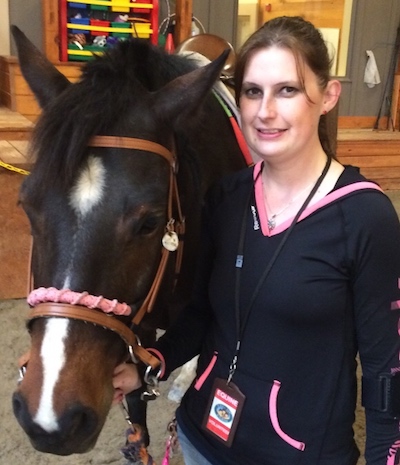
Trish Shaeffer mom of 3 active boys, a 9-year-old and 5-year-old twins who were born 2 months early and have special needs. She’s a peer supporter for Parent to Parent and volunteers with the United Cerebral Palsy Network, Special Olympics, and the United Way. She’s also an equine volunteer at Leg Up Farm. She’s married to her best friend and biggest supporter, Chris Shaeffer.

Author Jolene Philo

To get posts delivered to your inbox, enter your email address:

Delivered by FeedBurner

Archives

Categories

Related Posts

Promote Independence in Kids with Special Needs, Pt. 2

Promote Independence in Kids with Special Needs, Pt. 2

Promote Independence in Kids with Special Needs, Pt. 2

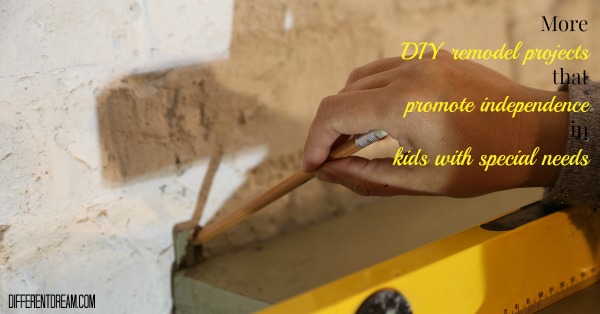
Did you know you can promote independence in kids with special needs with some DIY home remodeling projects? Guest blogger Paul Denikin, handyman and dad to a child with special needs, shared 2 remodeling tips in last week’s post. Today he’s back with 2 more projects to encourage independence and confidence in your home.

Remodel to Promote Independence in Kids with Special Needs, Pt. 2

Tip #3: Make Bathrooms Safe and Accessible

Most home accidents occur in the bathroom, so it is especially important to make repairs and modifications to make the bathroom as safe and accessible as possible for your children with special needs. There are several products available that require minimal expense and effort that will make your bathroom more accommodating.

For example, you can install grab bars on the shower walls and near the toilet to aid your child with getting in and out of the shower and up and down from the toilet. Keep in mind that your child should not rely on towel racks, toilet paper holders, or wall-mounted sinks to support his weight; these products are not designed to do so, and your child could get injured if he attempts to use them. Other products that increase bathroom safety and accessibility include rubber grip mats for the floor of the bathtub, bathtub or shower seats, transfer tub benches, handheld shower heads, and raised toilet seats.

Of course, there are much more involved projects that you could undertake to remodel your entire bathroom for your child with special needs. Some families opt to install vanities and sinks at lower heights. Others opt to install shower stalls that are wheelchair accessible. The size and scope of your bathroom repair and modification projects depend on your child’s needs and your budget.

Tip #4: Ensure Your Floors Do Not Pose a Danger to your Child

High pile carpeting and tile flooring are not ideal for children with special needs. High pile carpeting prevents wheelchair wheels from turning and rolling properly, and tile floors may be uneven and result in your child tripping and falling as he walks. Tile floors also can inhibit wheel movement or the smooth movement of walkers and crutches if something catches on the corner of an uneven tile. Tile flooring in a bathroom or kitchen is dangerous because these surfaces tend to be very slippery when wet. Slip-resistant flooring is recommended for bathroom and kitchen installations, and it is worth noting that tiles no larger than 2” x 2” are less slippery than larger tiles.

Laminate or low pile carpeting is a better option for children with special needs. These flooring options are durable and work well in high-traffic areas and often are easier to clean than high pile carpet and tile floors. If your child has allergies or asthma, laminate and low pile carpet are better options for those health issues because they do not hold pet dander and dust like high pile carpet does.

There are several simple ways to modify your home to make it more accessible to children with special needs. From wheelchair ramps to slip-resistant floors, you can make the repairs and accommodations that promote independence in kids with special needs.

More Ideas that Promote Independence in Kids with Special Needs

Now that you’ve heard all of Paul’s ideas, it’s your turn. Add your DIY remodel ideas that promote independence in kids with special needs in the comment box below.

Part 1

Do you like what you see at DifferentDream.com? You can receive more great content by subscribing to the quarterly Different Dream newsletter and signing up for the daily RSS feed delivered to your email inbox. You can sign up for the first in the pop up box and the second at the bottom of this page.

By

Paul Denikin is passionate about sharing his experiences on his site dadknowsdiy.com with working on DIY projects to benefit people with special needs children.

Author Jolene Philo

To get posts delivered to your inbox, enter your email address:

Delivered by FeedBurner

Archives

Categories

Related Posts

How Weighted Blankets Benefit Kids with Special Needs

How Weighted Blankets Benefit Kids with Special Needs

How Weighted Blankets Benefit Kids with Special Needs

Today’s guest post comes from the people at Special Needs Essentials, a website that specializes in products and resources for special needs families. Today’s post explains how weighted blankets benefit kids with special needs. 

How Weighted Blankets Benefit Kids with Special Needs

Have you ever heard of weighted blankets? These revolutionary tools provide pressure and sensory input, similar to a good hug. They are made of plastic pellets, evenly distributed in a quilted pattern in order to provide a widespread sensation of pressure. Studies have proven that the pressure provided by hugs or weighted tools enables the release of serotonin, a hormone that calms and relaxes the body. It also stimulates oxytocin, a hormone that promotes feeling of contentment and willingness of social bonding, among others.

This sensation is particularly valuable for individuals affected by autism and other sensory seeking individuals. They can use weighted blankets as a calming tool or simply as a regular blanket at night. During the day, you can try using it when you feel anxious, aggressive or just want to be comfortable. Sit and wrap yourself in your blanket or lay down and stay there a few minutes to hours, as long as you feel the benefits. At night, weighted blankets used in place of regular blankets will help your child go to sleep faster and stay asleep better.

Pay attention to buy a washable blanket made with non-toxic materials, as it is not always the case. As for the color, your child may appreciate the calming effect of solid blue. Some blankets have the ability to be warmed in your dryer or cooled in your freezer, thus providing the additional benefit of adapting to your child’s favorite temperature. Fringes can provide additional sensory input too, enabling the person to run their fingers around and play with them. The suggested blanket weight is 10% of your weight plus 1 pound, but it is best to check with your physician or therapist.

                 weighted blanket turtle       weighted blanket 2       weighted blanket washable

Weighted vests and weighted lap pads are also on the market, providing a different kind of pressure for sensory seeking individuals. Find your favorite weighted tool today!

Weighted blankets Special Needs Essentials Logo (Company)Special Needs Essentials is dedicated to offering essential materials that can enhance the quality of life for people with special needs, their families, and their support communities. SNE specializes in educational, therapeutic, play to learn, living aids, and sensory products. The intent of these skill-builders varies and includes providing sensory input, improving motor function, increasing cognitive development, and providing daily living assistance. Overall, SNE intends to enhance developmental skills in individuals of all abilities.

Your Take on Weighted Blankets?

Has your family had experience with weighted blankets? What do you think of them? Leave a comment in the box below. 

Read more about the research behind weighted blankets at these links:

Calming Effects of Deep Touch Pressure in Patients with Autistic Disorder, College Students, and Animals
Serotonin and Prefrontal Cortex Function: Neurons, Networks, and Circuits Molecular Neurobiology

Do you like what you see at DifferentDream.com? You can receive more great content by subscribing to the quarterly Different Dream newsletter and signing up for the daily RSS feed delivered to your email inbox. You can sign up for the first in the pop up box and the second at the bottom of this page.

By

Jolene Philo is the author of the Different Dream series for parents of kids with special needs. She speaks at parenting and special needs conferences around the country. She’s also the creator and host of the Different Dream website. Sharing Love Abundantly With Special Needs Families: The 5 Love Languages® for Parents Raising Children with Disabilities, which she co-authored with Dr. Gary Chapman, was released in August of 2019 and is available at local bookstores, their bookstore website, and at Amazon.

Author Jolene Philo

To get posts delivered to your inbox, enter your email address:

Delivered by FeedBurner

Archives

Categories

Related Posts