How Can an EA/TEF Parent’s Anxiety Be Held in Check Before their Child Starts School?

How Can an EA/TEF Parent’s Anxiety Be Held in Check Before their Child Starts School?

How Can an EA/TEF Parent’s Anxiety Be Held in Check Before their Child Starts School?

How can an EA/TEF parent’s anxiety be held in check before their child starts school? Karena Skibinski began asking herself that question several months before her son started preschool. In today’s post, which is part of Different Dream’s ongoing series for EA/TEF Awareness Month, Karena writes about six actions that helped her the most. She hopes they will help you too.

Three years ago, we were still in the thick of our NICU stay with our son, Lincoln. Shortly after he was born, he was rushed to the nearest children’s hospital (which, turns out, is one of the best in the nation) and was then diagnosed with Esophageal Atresia (EA), Type C. Two major surgeries, one G-tube, and 87 days later, he was discharged. His first 18 months were a blur and were filled with various doctor appointments, dilations, scopes, and various therapies.

Fast forward to now. He turned 3 this past October, and things have been going well. Instead of all of those appointments, our days are filled with nature walks, Lego, potty training, playing with his big brother, and trying new foods. Lincoln reached a big milestone in August. He started preschool. He attends the same preschool as his big brother, so he was somewhat familiar with the building, some of the teachers, and the general morning/pickup/drop off routine.

I was a different story. Aside from when Lincoln was discharged from the NICU, his starting preschool was what I was most anxious about. This would be the first time he’d be in the care of someone else, as we made it work for me to stay home with him those first few years. I had so many questions. How would he adjust? How could the teachers keep an eye on him with so many other kiddos in the classroom? What about the sickness that inevitably comes along with starting school? All of these questions—and about 100 more—were swirling around in my mind at least a few months before the first day.

Here are 6 things that made the transition to preschool easier for our family.

  1. Therapy for myself: I’ve been in therapy for several years now, and it’s been one of the best things for my overall well-being. I am a huge advocate for therapy! It’s truly wonderful to have a scheduled space with a trusted therapist to continue processing the trauma related to Lincoln’s birth and the fears that go along with raising a medically complex child.
  2. Implementing a solid general routine: This is foundational for any kiddo, and there is lots of research supporting the efficacy of a good routine. It builds predictability, which in turn builds confidence and space to learn, explore, and grow.
  3. Meeting with the teachers beforehand, and ongoing open communication: Our school gave us the opportunity to meet with Lincoln’s teachers a couple weeks before school started. We also filled out paperwork related to general topics about Lincoln (e.g. what he likes, what he doesn’t like, etc.) as well as about his medical background, and a general mealtime plan that we went over face-to-face. This gave me peace of mind!
  4. Getting a copy of the breakfast/lunch/snack menu and being in touch with the school chef: We went through the menu and identified foods that Lincoln may need modified or substituted (e.g. carrots, grapes). This is kept in the kitchen.
  5. Providing a copy of this informational handout as well as a document that contained all of Lincoln’s medical background/medications: I found an outline similar to this in one of the EA/TEF Facebook groups that I am in. I emailed the completed document to the school about 4 months prior to Lincoln starting school. It was a way to get communication started about his condition. I’ve provided a short, one-page document with Lincoln’s medical background and medications. It is kept in his file at school. Should EMS ever need to be involved, the document provides them with quick information related to his medical needs.
  6. Providing “just-in-case” items: I’ve heard some families provide yogurt for their EA/TEF kiddo to have during lunch time, but we’ve only provided a small can of Coke for the teachers in case of a “stuckie.” Coca Cola has been most beneficial for Lincoln in that situation.

Lincoln’s been in half-day preschool 4 days a week for one whole semester now, and things have been better than I could’ve imagined. Luckily we have had no issues, and going to school has had a positive impact on his overall development and our family dynamics as well!

Do you like what you see at DifferentDream.com? You can receive more great content by subscribing to the monthly Different Dream newsletter and signing up for the daily RSS feed delivered to your email.

Photo by Mourizal Zativa on Unsplash

By

Karena Skibinski is a mother and occupational therapist. After taking a few years off to be home with her children, she recently returned to working weekends in a hospital setting. It’s been such a blessing to her and her family. When she’s not busy running around with her two boys (Lennox is 5 and Lincoln is 3) or working, you can find her in the kitchen trying new recipes, going on long walks with her two pups, or taking an afternoon nap. Through her work, her mission is to bring more awareness to EA/TEF and to provide reassurance to EA/TEF families that they aren’t alone.

Author Jolene Philo

To get posts delivered to your inbox, enter your email address:

Delivered by FeedBurner

Archives

Categories

Related Posts

Special Needs Homeschooling: The Ups and Downs

Special Needs Homeschooling: The Ups and Downs

Special Needs Homeschooling: The Ups and Downs

Special needs homeschooling is full of ups…and downs. Guest blogger Lisa Pelissier knows this from experience. In this post she describes her adventures in homeschooling, which began long before she discovered she had joined the special needs homeschooling tribe.

I wanted to homeschool before I even had children. I didn’t even need to make a list and check it twice to weigh one side against the other.

I wanted to raise my kids to love God.
I wanted to spend time with them and have them spend time with each other.
I wanted to do all the fun things you can do with little kids, like growing bean seeds, dressing up like Ancient Romans, and making Native American huts out of hot glue and cardboard for authenticity, of course. (See image below—lol).

I dove in, not without some fear because I didn’t know what I was doing or how it was going to turn out.

When we began homeschooling, I was a mom of two little boys, then almost five years old and eighteen months. It didn’t take me too long to figure out that homeschooling was harder than it looked. Entertaining a baby while trying to teach Latin and Greek to a disinterested four-year-old (I was ambitious in those days) kept me on my toes.

But there was something else going on, too. Every subject was a battle. Once my son got used to addition, then came subtraction. It was something new, and therefore something that must be rejected with howls of misery and a tantrum on the floor.

When I tried to teach him to spell, he told me he didn’t really care how other people spelled things. He was going to do it his way. It took me five years of struggle before I convinced him that it might be nice if other people could read what he wrote.

When he was nine—and I had a baby girl and another on the way, we got his autism diagnosis. My construct of a happy homeschooling family fell apart. Nothing had changed. But, if my son had anything to say about it, nothing ever would. He was going to protest every new thing I taught him. He was going to be difficult. And he was. He’s a lovely human being. But he’s a pain in the butt to teach.

When my second boy was twelve, he got sick with PANS (see my previous post here for more information). My world fell apart for a second time. By the time he graduated from high school, he was on his way to good health, at last. Then my girls got sick. In the midst of their difficulties came the divorce. It’s not been an easy road for any of us.

But through all the illnesses, both neurological and physical—depression, anxiety, dyslexia, dysgraphia, dyscalculia, OCD, autism, PANs, and more—homeschooling has been a blessing. I’ve been able to tailor our studies to accommodate my kids’ disabilities.

One of them needed everything read aloud—and I mean everything—to him all the way through school. So we read aloud.

One needs to travel the schooling path more slowly and more independently, so I’m able to scale back.

It doesn’t matter if they graduate on schedule or much later than their same-age peers. It matters that they’re still making progress. And they are.

Has it been hard on me? Absolutely. Would I change it? Uh… some days I want to move to Italy and never look back. But the rest of the time, I’m grateful for the journey we’ve had, as I get to know my kids better, to understand their struggles, and to understand myself as we continue to navigate the ups and downs of special needs homeschooling.

Do you like what you see at DifferentDream.com? You can receive more great content by subscribing to the monthly Different Dream newsletter and signing up for the daily RSS feed delivered to your email.

Photo by Aaron Burden on Unsplash


By

Lisa Pelissier lives in Oregon where she is a homeschool mom and author of five middle-grade fiction novels, the second-grade Monsters series, and a YA fantasy novel. Lisa owns SneakerBlossom Books, offering Christian, classical homeschool Study Guides and curriculum. She blogs at Eleventh Willow, offering encouragement for Christians parenting the mentally ill. She also works as a freelance copy editor, copy writer, and a marketing editor. In her spare time Lisa enjoys playing the piano and writing books.

Author Jolene Philo

To get posts delivered to your inbox, enter your email address:

Delivered by FeedBurner

Archives

Categories

Related Posts

Navigating an IEP Meeting During the Coronavirus Shutdown

Navigating an IEP Meeting During the Coronavirus Shutdown

Navigating an IEP Meeting During the Coronavirus Shutdown

Navigating an IEP meeting during the coronavirus shutdown can be tricky, but it’s not impossible. Guest blogger Jessica Temple offers tips parents can use to be on top of their game and remain tearless now and after the shut down ends.

We recently had an emergency IEP meeting, the second one we’ve attended, for our 4-year-old son who has autism. My husband and I were woefully unprepared for the first meeting.  We didn’t know how to prepare, what our rights were, or how to work with the system.

This second meeting came almost 12 months afterwards. I have learned a lot during that year about what goes into IEPs, what to say, what not to say, what rights parents and our special needs children have, and how the meetings are run. I am here to share tips about navigating an IEP meeting during the coronavirus shutdown without shedding tears. The goal is always to get the appropriate IEP for your child. (Bonus tip: Never say best or most, just appropriate.) 

Tip #1: Find Advocates

Find someone who has a great deal of knowledge, and ask, ask, ask! This can be as informal as a friend who has gone through many IEP meetings, contacting the Parent Training and Information Center through your state, or hiring a formal IEP or disability rights advocate. I used the free services through my state. They were kind enough to offer me 3 people to talk to. These individuals provided documents about our rights, important buzzwords, as well as IEP document phrasing and what to say if the team denied an accommodation we deemed necessary. They helped me to create and word several goals and services that would be the most useful to my son at his present age and stage. They also provided snippets of case law should our rights be violated. 

Tip #2: Attend Workshops

Many states have free workshops through their school systems. Different special needs societies also have free workshops dedicated to children’s education, special needs, and IEPs. We attended a workshop a before our IEP meeting. They went through every page of a blank IEP and discussed what services are appropriate when, how to ask for what’s needed, how to have it phrased in the actual document, and what to do if the IEP team pushes back. On top of that, they said our local school system has a free,special needs lending library. They also brought a large selection of books specific to IEPs. 

Tip #3: Read Books about IEPs

I flipped through many of the books at the workshop, and selected the four that I found most useful and relevant. They discussed each component of the IEP, the case law related to the IEP, and step-by-step ways to solve problems. The books had templates for letters to write to the IEP team, examples of questions to ask, instructions for writing effective goals, and strategies to resolve disputes. The four books I recommend are:

The Art of Advocacy by Charmaine Thaner, M.A.
Negotiating the Special Education Maze by Winifred Anderson, Stephen Chitwood, Deirdre Hayden, and Cherie Takemoto
The Complete IEP Guide by Lawrence M. Siegel
From Emotions to Advocacy by Pam and Pete Wright

Tip #4 Attend a Local Support Group

We attended several local autism support group meetings. The individuals who attend these meetings have often been in the special needs world for a long time and have experience with IEPs. They provided tons of handouts, resources, and had another lending library! They were supportive, understanding, and tried to answer my questions. 

Tip #5: Access Online Resources

I have used the internet to find local support groups and Facebook groups. I found local Facebook groups to most beneficial as other ones were either too general or didn’t provide helpful enough information. Websites specific to a specific disability explained what should or could be included in the IEP for that disability.

These websites have copious information related to laws and IEPs: 

Wrights Law 
A Day in Our Shoes
The Wrightslaw Way
National Disability Rights Network
Education Law Center

Tip #6: Listen to Podcasts

I love podcasts that provide useful help with IEPs, important perspectives, and information on disability rights. Here are my favorites:

Don’t IEP Alone by Lisa Lightner
LOMAH Special Needs Podcast
Thriving in The Midst of Chaos with Jessica and Lewis Temple 

Tip #7: Coronavirus and IEPs

Coronavirus has thrown a monkey wrench into IEPs. These resources may be very helpful  for you to learn more about how this may affect your child, what to do in this unprecedented time, and what your rights are:

United States Department of Education California Department of Education American Bar Association 
National Center for Special Education in Charter Schools 
Parent’s Place of Maryland

Tip #8: Coronavirus and Homeschooling

The following resources may be very helpful to keep your child’s IEP and services on track until schools are in session again and help you with homeschooling:

A Day In Our Shoes Homeschooling
Resources School Closure Toolkit
Easter Seal

IEP  meetings are stressful. They are a lot of work, and there is a lot to know. However, if you utilize these resources and arm yourself with knowledge, you will be tearless, successful navigating an IEP meeting during the coronavirus shutdown, and satisfied with the IEP you and your child’s team put together. 

Do you like what you see at DifferentDream.com? You can receive more great content by subscribing to the monthly Different Dream newsletter and signing up for the daily RSS feed delivered to your email inbox. You can sign up for the first in the pop up box and the second at the bottom of this page.

By

Jessica Temple, PsyD, ABPP-CN, is a board-certified adult clinical neuropsychologist. She has two children who have special needs. She and her husband, Lewis, host a podcast called Thriving in The Midst of Chaos, where they talk about all aspects of special needs including getting a diagnosis and treatment, self-care, relationships, transitioning to adulthood, school, and finances. They created Thriving in The Midst of Chaos to offer support to others in the special needs world as well as to provide an easy way to find the most useful resources. They aim to share helpful resources with others, advocate for improvement, change in the special needs world, and offer a different perspective on parenting.    To find out more about how Jessica’s work can help you, contact her at fubarpod@gmail.com or @midstofchaospod on all social media platforms.  

Author Jolene Philo

To get posts delivered to your inbox, enter your email address:

Delivered by FeedBurner

Archives

Categories

Related Posts

Annual Review Meeting: 3 Questions to Ask

Annual Review Meeting: 3 Questions to Ask

Annual Review Meeting: 3 Questions to Ask

Annual review meeting time is here, which means you should prepare now in order to advocate for (or with) your child about next fall’s school placement. Dr. Liz Matheis suggests using these 3 questions to determine what next year’s placement and program should be.

Annual review meeting season is upon us, and it’s time to start thinking about your child’s program for next fall. Based on the information you will be gaining from your child’s teachers, case manager, and related service providers, you and the team will be able to make an assessment of the level of support your child needs across his classes, the type and amount of therapy, as well as supplementary services.

Annual Review Meeting Question #1

Have my child’s goals been achieved? If your child has a pull-out resource program in any of her subjects or has been placed in a self-contained class, goals were established at your last Annual Review meeting. Based on progress reports from the last year, feedback gained during parent-teacher conferences, and your observations, assess if your child has made adequate progress with her goals.

If she has, it may be time to create more challenging goals in particular areas of growth. If your child has not made progress, it may be time to assess why that is the case and decide if your child needs greater support in that particular subject or area of development.

Annual Review Meeting Question #2

Does my child’s program need to be more or less restrictive? Depending on where your child is making progress or needs greater support, this is the time to decide where your child’s academic program needs to be more or less restrictive. In other words, does your child need more or less support in each subject? If your child needs the curriculum to be modified because there is a gap in certain skills, then your child’s program may need to be more restrictive with the help of a pull-out resource program. If your child is needs accommodations but is able to keep up with the general education curriculum, then your child may need a less restrictive program with the help of an in-class resource program, or in-class assistance program.

Annual Review Meeting Question #3

How is my child progressing behaviorally, socially, and emotionally? Although this is not a discussion strictly about academics and homework or the ability to take a test, this area of development is equally as important as the conversation about the type of program your child needs to learn and succeed. In my experience, if a child does not have the emotional stability to manage the demands of being a member of the classroom, receiving academic instruction will be very difficult.

Therefore, this is another very important area for you and your child’s annual review team to assess by asking a few more questions. Is your child able to be in a class with other students of varying skill abilities and still comfortably perform at his level? Is your child able to develop and maintain friendships? How does your child respond to feedback? Is your child able to handle disappointment? Can your child handle a change in the routine without becoming too upset?

Annual review season can be a stressful time of the year as you think about and plan ahead for the next school year. But by assessing your child using these questions, you will be able to make decisions and advocate for your child’s program and related services at the annual review meeting and beyond.

Do you like what you see at DifferentDream.com? You can receive more great content by subscribing to the monthly Different Dream newsletter and signing up

By

Dr. Liz Matheis is a clinical psychologist and school psychologist in Parsippany, NJ. She offers support, assessments, and advocacy for children who are managing Autism Spectrum Disorders, ADHD, learning disabilities, and behavioral difficulties, as well as their families. She is also a contributor to several popular magazines. Visit www.psychedconsult.com for more information.

Do you like what you see at DifferentDream.com? You can receive more great content by subscribing to the monthly Different Dream newsletter and signing up

Author Jolene Philo

To get posts delivered to your inbox, enter your email address:

Delivered by FeedBurner

Archives

Categories

Related Posts

The Amazing Shrine School for Children with Special Needs

The Amazing Shrine School for Children with Special Needs

The Amazing Shrine School for Children with Special Needs

The Shrine School in Memphis, Tennessee is one of a kind. I visited it in late September of 2017 and was blown away by the building, the teachers, the staff, the parents, and most of all, by the 150 students served there.

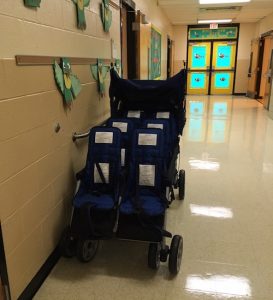
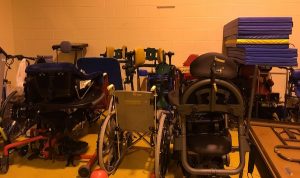
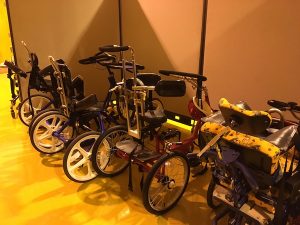
I knew this school was something special after spying this multiple child carrier in the preschool hallway.

The school, part of Shelby County Schools, has a unique history and collaboration with the Shriner Organization. The Shrine Board of Control provides funding for special services that benefit the students who attend the school. To be eligible to attend, students (who range from age 3 to 21) must have an IEP, and the need for nursing services must be written into their IEPs. The services offered are amazing. Here are pictures of a few.

Breakfast and lunch for all students. The little girl in the chair is eating breakfast. The cafeteria provides special meals for students who require pureed food, thickened liquids, gluten-free and the like.

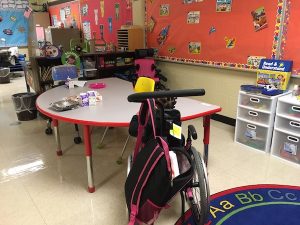
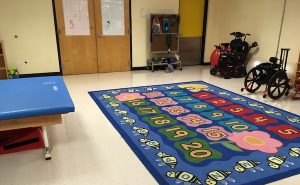
Full time, on site physical, occupational, and speech therapists who do some work in the therapy room above or in the classroom.

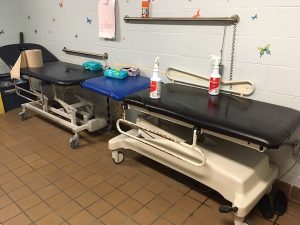
Special changing tables in the locker rooms for students whose IEPs include water therapy in the pool shown at the top of the page.

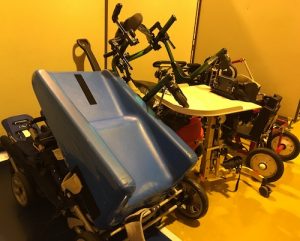
Adaptive PE equipment for tots,

tweens,

teens, and young adults.

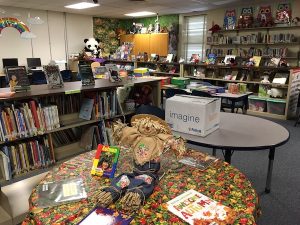
A fully stocked library run by Ms. Posey, which I think is the best possible name for a children’s librarian.

A life skills area where students learn cooking and housekeeping skills.

The Shrine School also has a full time RN who works with students and oversees numerous LPNs that serve each wing of the school (preschool, elementary, middle school, and high school). Class sizes range from 8–13 students. Each classroom has a full time teacher and at least 2 teaching assistants. The principal has been there 18 years and is passionate about the students. The full time guidance counselor, who first contacted me about speaking at their fall parent resource fair, knows every student by name and is constantly searching for resources for children and families.

Here are a few of the Shelby County resources at  the Resource Fair.

Meet Brittany, a Shrine School Alum, who now works for The Arc in the Memphis area and represented the organization at their booth.

Speaking of families, the Shrine School parents are dedicated and involved. Here are a few of the over 100 who attended the Fall Resource Fair.

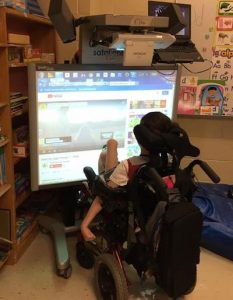
The work being done by and with the students dropped my jaw more than once. In 1 classroom, a little boy operated the smart screen with his foot.

He knew exactly how to get to the channel he wanted.

At the end of the day, I visited a middle school classroom. The speech therapist wheeled one of the students into the room and announced that the young girl had “found her voice” that day. “Say hello to everyone,” she instructed a girl with dancing eyes and a radiant smile who was unable to use her limbs or speak because of cerebral palsy.

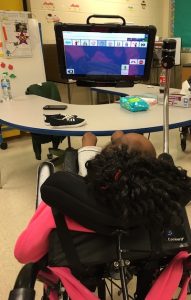
Then, for the first time in her life, the young girl used her gaze-activated communication board to say, “Hi, how are you?”

Gaze-activated communication board in use!

I watched the teachers and associates lovingly gather around her chair to chat with the student and listen to what she had to say. They kept their cool, but I was in tears.

“This school is amazing,” I told the guidance counselor later as I recounted the story.

“Miracles like that happen here all the time,” she said. “Children take their first steps, start talking, and learn to use the bathroom.”

At the end of the day, I went back to my hotel room grateful to the Shriners for their commitment to children with special needs. But my gratitude pales in comparison to that of the parents.

One after another said, “My child loves it here, and so do we. This is the best school ever.”

And do you know what I think?

They’re right.

Do you like what you see at DifferentDream.com? You can receive more great content by subscribing to the quarterly Different Dream newsletter and signing up for the daily RSS feed delivered to your email inbox. You can sign up for the first in the pop up box and the second at the bottom of this page.

By

Jolene Philo is a published author, speaker, wife, and mother of a son with special needs.
Author Jolene Philo

To get posts delivered to your inbox, enter your email address:

Delivered by FeedBurner

Archives

Categories

Related Posts

5 More Ways to Build Positive Parent-Teacher Relationships

5 More Ways to Build Positive Parent-Teacher Relationships

5 More Ways to Build Positive Parent-Teacher Relationships

Are you looking for ways to build positive parent-teacher relationships as the new school year begins? This blog series is based on what I, Jolene, learned during 25 years as an elementary teacher. My classroom was inclusive, with about 1/3 of the students receiving resource room services as specified in their IEPs and 2/3 of the students without IEPs. Last week’s post looked at 5 tested tips that can build positive parent-teacher relationships. This week’s list contains 5 more.

5 More Ways to Build Positive Parent-Teacher Relationships

Tip #6: Write a Thank You Note

Sometimes teachers or other educator in the school make a spectacular difference in a child’s life. Whether that person creates a special bond with your child, advocates for more services, or creates an environment that school a safe and happy place, send a thank you note. This strategy not only gives the teacher the praise due her, but also builds good will between parent and teacher. From experience, I can say that a sincere thank you note can bring tears to a teacher’s eyes when she needs encouragement.

Tip #7: Teach Your Child to Give

Does your child get enough to eat, have clean clothes to wear, and a comfortable place to come home to each day? If your answer is yes, your child is richly blessed. But children who want for very little can begin to feel entitled rather than grateful for their blessings. One way to boost their gratitude quotient is to teach children to give. Have them sort through toys for nice ones to give away. Encourage to give some of their allowance to church. Choose a family service project or raise money for worthy causes. Children who learn to give bring that attitude to school. They help create compassion in their classroom and in their friendships. Their kindness also builds positive parent-teacher relationships.

Tip #8: Promote Independence

When children are small or not developing as quickly as their peers, it’s often easier to do things for them than to teach them to do things for themselves. But it’s crucial for parents to teach kids age- or ability-appropriate skills that lead to greater independence as soon as they’re able to learn them. Children with skills that make them more independent feel empowered and more confident. They are more likely wait to ask for help until they need it and less likely to develop an attitude of entitlement. Like children who learn to give, these children bring their healthy attitudes to school and change the climate in their classroom. Educators respect and think positively about parents who encourage age- or ability-appropriate independence in their children.

Tip #9: Offer Solutions

When problems arise at school, try to think of them as opportunities to build better and more positive parent-teacher relationships. Ask questions to find out what the problem is and about how it could be fixed. Think about the solutions offered, and you agree with them, that’s great. The problem can be solved. But if the solutions aren’t adequate, offer some of your own. This can feel intimidating, but it can be done. You are part of your child’s education team, and you are the expert on your child. Present your solutions calmly, rationally, humbly, and with a willingness to listen to the opinions of others. Working together to solve problems on behalf of the child can create positive parent-teacher relationships.

Tip #10: Follow the Biblical Model

If your best efforts at solving a problem fail and the conflict can’t be resolved, you must advocate for your child. The Bible provides a model for conflict resolution. First, go to the teacher involved about the problem one-to-one. If that is unsuccessful, ask for a meeting with the teacher and whoever is directly over that teacher–probably the building administrator or a special education administrator–and try to resolve the problem there. If that doesn’t work, ask for a meeting with the administrator at the following level. Advocate and continue until resolution is reached. To learn more about legal rights of children with special needs at school, visit WrightsLaw.com. It contains a wealth of information.

There you have them. 5 more ways to build positive parent-teacher relationships for a new school year. To check out the first 5 tips, check out Part 1 of the series. Also, leave your best tips in the comment box so readers can learn from you, too.


Do you like what you see at DifferentDream.com? You can receive more great content by subscribing to the monthly Different Dream newsletter and signing up for the daily RSS feed delivered to your email.

By

Jolene Philo is a published author, speaker, wife, and mother of a son with special needs.
Author Jolene Philo

To get posts delivered to your inbox, enter your email address:

Delivered by FeedBurner

Archives

Categories

Related Posts