by jphilo | Apr 27, 2010 | Current Events
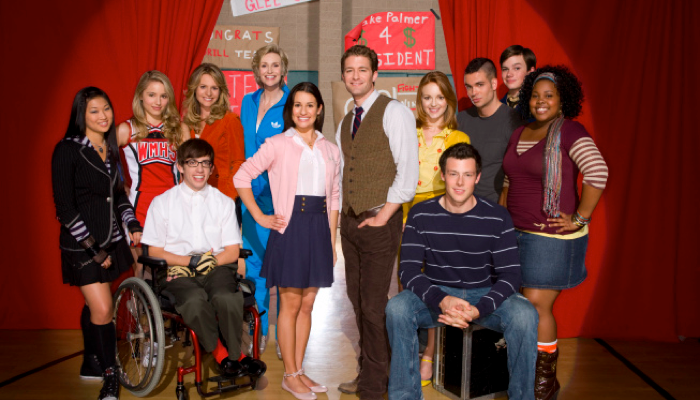
When I first watched Glee, I was so excited. Being a shallow, escapist kind of girl, I love musicals. A TV show providing a weekly dose of unreality floated my boat. And the idea of a bunch of high school losers breaking into song and dancing was my personal high school dream come true.
Of course, many of the characters in the show are cliche. The Glee Club is full of them – airhead cheerleaders who can’t stand the bossy and talented Jewish girl who looks a lot like Barbara Streisand, a couple angry jocks, a flaming gay guy, and a spunky fellow in a wheelchair. Faculty members include a dumb jock coach ,a pinch-faced principal, a neurotic guidance counselor, and the sincere and sensitive underdog Spanish teacher who becomes the Glee Club advisor. And when the parents appear, which doesn’t happen often, they’re either hypocritical conservative Christians, hip gay couples or sensitive single mothers.
For several episodes, I overlooked the cartoon characterizations for two reasons. First, the musical numbers were the perfect way to escape and so fun to watch. Second, Jane Lynch was absolutely hilarious as Sue Sylvester, director of the Cheerios drill team and arch enemy of the Glee Club.
But in the last few episodes, the gist of every show has been who’s going out with who, who’s having sex with who, and who will lose his/her virginity next. Every musical number is awash in sexual innuendo. Every story line leads to a bedroom. Maybe that’s a fair depiction of high schools full of testosterone-inflamed boys and estrogen-driven girls. But it can’t be the only thing kids do. I mean, some of them have homework, don’t they? Or go to work or blow up stuff in science class or practice those snappy little dance numbers? However, the writers are deep into the sex theme. Apparently, they’re so uncreative, they can’t think of anything else to write about.
Well, I’ve had enough. No more Glee for me. I’m going back to the DVDs of The Dick Van Dyke Show. The Hollywood twin beds and pristine PJs the Petries wear every evening aren’t any more realistic than Glee’s hot pants, but the singing and dancing ranks right up there. And the writing iss stellar. Do you suppose Carl Reiner would come out of retirement and get Glee back on track?
I wish.

by jphilo | Apr 26, 2010 | Current Events
“How long has our church been meeting in the high school?” someone asked at Small Church the other night.
“Nine years,” I said. It’s easy for me to keep track since we started using the auditorium the spring Allen graduated from high school.
Has it really been nine years? Nine years of hauling sound equipment for the worship band, setting up the nursery in hallways, and Sunday school in the foyer. No wonder the storage bins full of nursery toys and Sunday school materials are wearing out. No wonder the people who pack the trailer were dog tired.
But this spring, a little spring has returned to their step.
A little zip is zippadying their doo-dahs.
A little vim is vitalizing their vigor.
Why?
Because in a few months, our new church building will be finished. The sound equipment will stay put from week to week. The nursery will have four solid walls where our babies will be safe. The Sunday school classes will meet in rooms – maybe not completely finished when we move in, but they’ll be put to rights soon. Very soon.
Living through it, nine years seemed like an eternity of hauling tubs and hustling to get out of the building on time each week. But looking back, it seems like hardly enough time for a small group of people to find property and pay for it, raise half a million dollars, secure a loan for the remaining costs, and build a church. And looking forward, nine years seems like nothing compared to the enormity of the task – spreading the good news of a risen Savior so others will come to faith and spend eternity with Him.
Once we’re in our new building, what will God do then? How will he change us? What will the next nine years bring?

by jphilo | Apr 13, 2010 | Current Events
If you’re checking in for wedding news, please be patient. As soon as I get through the post-wedding pile up, you’ll get the skinny. In the meantime, maybe you’ll enjoy this post about aging brains. I’ve been saving it for a busy day like this, and being rather tired, my brain is feeling its age, too.
In a recent blog post, I mentioned a study of teen brains which motivated me to reroute my morning walks to avoid teen drivers. Of course, another choice would have been to stop walking daily. But information in a second NPR news report on aging brains nipped that idea in the bud.
Brain researcher Gary Small shared this old fogey bad news first: “Reaction time is slower,” he says. “It takes us longer to learn new information. Sometimes it takes us longer to retrieve information, so we have that tip-of-the-tongue phenomenon — where you almost have that word or that thought. That’s typical of the middle-age brain.”
Well, I was despondent upon hearing such an accurate description of my brain, but then Small shared the good news that there is “continued improvement in complex reasoning skills as we enter middle age…This increase may be due to a process in the brain called ‘myelination.’ Myelin is the insulation wrapped around brain cells that increases their conductivity — the speed with which information travels from brain cell to brain cell. And the myelination doesn’t reach its peak until middle age. By this point, says Small, ‘the neuro-circuits fire more rapidly, as if you’re going from dial-up to DSL.’ Complex reasoning skills improve, and we’re able to anticipate problems and reason things out better than when we were young.”
With those words, I preened a bit. After all, myelin was the stuff teen brains lacked, but middle-agers like me have plenty of the stuff. And, Small added, older people have more empathy than teens.
But his next words kept my head from swelling too much. To keep middle-aged brains growing, studies show that learning new skills is important. Another study by brain researcher, neuroscientist Art Kramer, from the University of Illinois, found that memory can improve with treadmill workouts. “Over a six-month to one-year period,” Kramer says, “three days a week, working up to an hour a day, people improved in various aspects of both short-term and long-term memory.”
So there it is. Daily walks aren’t just good for the body, they’re good for the brain, too. There’s no wiggling my way out of them now. How can I with examples like Small and Kramer? At the end of the radio report the reporter described their daily exercise routines: “Kramer, 56, goes to the gym four or five days a week, getting aerobic exercise on a stationary bike and strength training by lifting weights. Small, 58, does a New York Times crossword and numbers puzzle every morning, as well as a series of toning and stretching exercises and at least 20 minutes of aerobic exercise each day.”
Sigh. Time to take this aging brain on another walk.

by jphilo | Mar 24, 2010 | Current Events
Since the weather has improved, I’ve been enjoying walks along our gravel road after an almost two months hiatus. Now and then, I take a long hike towards town, passing the grocery story and the community college to get to the lovely walking trail in the park. But after hearing a recent NPR report about teen brain research, I wonder if I’m taking my life in my hands walking near the college, with young adults driving like maniacs, desperate to get to class on time.
In the radio story, neurologist Francis Jensen said, “scientists used to think human brain development was pretty complete by age ten.” She went on to say that a crucial part of the brian, the frontal lobes, aren’t fully connected. “It’s the part of the brain that says: ‘Is this a good idea? What is the consequence of this action? It’s not that they don’t have a frontal lobe. And they can use it. But they’re going to access it more slowly.”
According to the article, “the nerve cells that connect teenagers’ frontal lobes with the rest of their brains are sluggish. Teenagers don’t have as much of the fatty coating called myelin, or ‘white matter,’ that adults have in this area. Think of it as insulation on an electrical wire. Nerves need myelin for nerve signals to flow freely. Spotty or thin myelin leads to inefficient communication between one part of the brain and another.”
Myelin sheath…scars on the fatty coating are the defining mark of multiple sclerosis, the illness that robbed my dad of the ability to drive, walk, write, and see. And here’s a Harvard-level neurologist saying the myelin coating of teens isn’t developed. Yikes!
If this is true should our government be issuing drivers’ licenses to teenagers without fully formed brains or thick myelin coatings? And what was I doing walking on a road populated by teenagers racing to get to class while texting and eating breakfast, teens whose brains aren’t fully able to ask, “Is this a good idea? What is the consequence of this action?”
SInce my frontal lobes are formed and fatty coatings are something I have in abundance in many parts of my aging body, the onus is on me. Time to change my route or start my walk a half hour earlier so I’m long gone before the myelinless, lobeless drivers hit the road. So many people in the younger generation are dear to me even though their brains are still developing. I’d like to know them after their brains are in working order.

by jphilo | Mar 12, 2010 | Current Events
For the past few weeks, staying positive has been a struggle. Why? For starters, the fourth quarter of this interminable winter finally melted away, creating a flood zone. So after two successful speaking engagements (at this point “successful” means they weren’t postponed because of weather, not that I was mobbed by crowds of adoring fans), I’m wondering if we should rent an ark for the three scheduled next week.
I have to do something since earning a speaking fee is hard when you can’t speak, and selling books isn’t easy without a crowd. These days, I’m constantly reminding myself that what I do isn’t about making money. It’s about taking the parenting experiences God’s given our family and using them to minister to parents who need the hope while raising their kids with different dreams. Apparently God knew I was sorely in need of a little hope myself and sent some along in American Profile, a weekly magazine that comes with our Saturday paper.
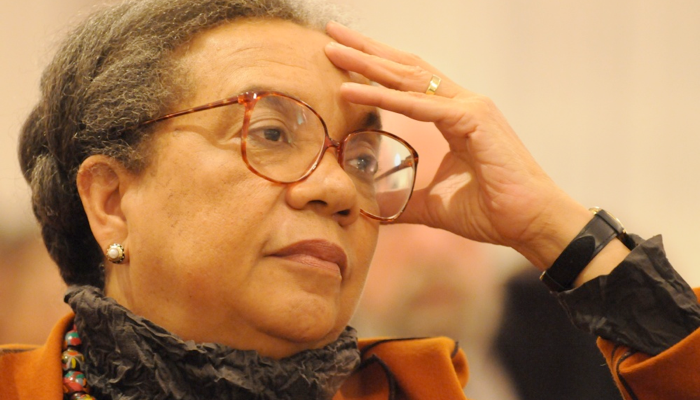
One of the articles in the February 21-27, 2010 issue was about Marian Wright Edelman, a woman who has devoted her life to crusading for disadvantaged kids. Near the end of the story, Giving Children a Voice, she says, “My faith doesn’t tell me that you have to win. You’ve got to get up every day and decide to be the best that you can. You don’t give up; you persevere. We don’t have the right to give up on any child.”
Marian’s words were a godsend, shifting my attention from dollars earned to lives changed, my mindset from giving up to going on, and my attitude from self-centered to child-centered. You can benefit from her perspective by reading the entire article at www.americanprofile.com.
Ever since reading the story, one sentence pushes me out of bed every morning.
“We don’t have the right to give up on any child.”
“We don’t have the right to give up on any child.”
“We don’t have the right to give up on any child.”
What’s it doing to you?

by jphilo | Mar 9, 2010 | Current Events
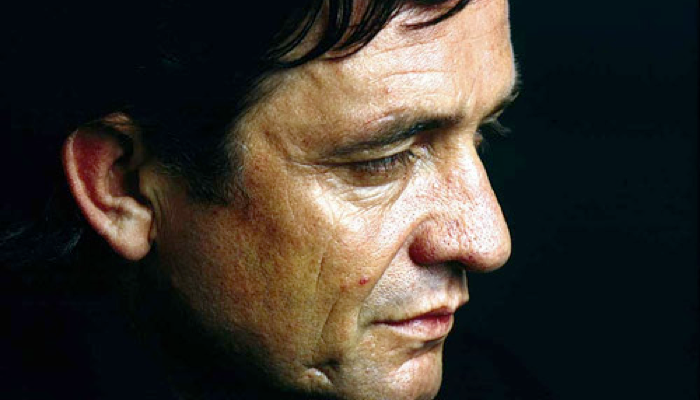
On a recent road trip to Minneapolis, I listened to the NPR interview show Fresh Air, which rebroadcast an interview Terry Gross did with Johnny Cash in the late 1990s. He was in the news because 1) February 26 was the anniversary of his birthday, and 2) the last in his American Recording Series, Ain’t No Grave, was released to coincide with his birthdate
I wasn’t a country western fan in my youth, and my generation spent more time ridiculing Johnny Cash than listening to him. But Gross’s interview with the aging singer and his obvious love of music made the interview a delight. You can listen to it or download the transcript by clicking here.
After the rebroadcast, Gross interviewed Rick Rubin, the record producers who collaborated with Cash on the American Recording Series. Gross and Rubin spent much of the interview talking about the CD in the boxed set which is all Cash singing his favorite hymns and spirituals solo. In the interview, Rubin describes the impact of Cash’s witness through an everyday moment. To hear what Rubin said or download that transcript, click here.
Once you listen, you may understand why Johnny Cash is my new homeboy.
Thanks, man in black.