Sweet Joy in the Middle of Goodness

Sweet Joy in the Middle of Goodness

Sweet Joy in the Middle of Goodness

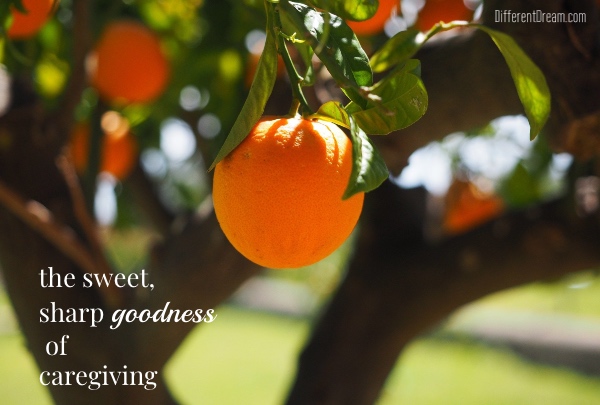
Sweet joy in the middle of goodness was an unexpectedly delightful part of our trip to an Arizona fruit orchard in January. I walked around in shirtsleeves and sandals, admiring trees laden with yellow and orange fruit. I breathed in the tang of fresh citrus. I sampled variety after variety of grapefruit, oranges, lemons, and limes with greedy joy.

The orchard was heady fare for a midwesterner eager to escape an Iowa winter for a week. When it was time to leave the orchard, I didn’t want to go. And I didn’t want to leave Arizona’s warmth and sunshine when our vacation ended.

Even so, part of me was ready to return home and resume interviews with parents raising kids with special needs and disabilities for a book proposal about stress and compassion fatigue in caregiver.

I was ready to return to the sweet joy of hearing their stories.
The sweet joy of witnessing their pride in their children.
The sweet joy of crying with them in their grief.
The sweet joy of learning from their wisdom.
The sweet joy of being in the middle of goodness incomprehensible to those not part of our world.

Talking to these families, on the phone or in video chats, has been as sharp and delicious as an orange eaten in a citrus grove. Our conversations take me back to my days as a caregiver, and we connect as only parents of kids with disabilities and special needs can. As they describe their lives, common threads, common needs, and common desires emerge. Here are 5 many parents have expressed.

To read the rest of this post visit Key Ministry’s blog for parents raising kids with special needs.

Do you like what you see at DifferentDream.com? You can receive more great content by subscribing to the monthly Different Dream newsletter and signing up for the daily RSS feed delivered to your email inbox. You can sign up at the bottom of this page.

By

Jolene Philo is a published author, speaker, wife, and mother of a son with special needs.

Author Jolene Philo

To get posts delivered to your inbox, enter your email address:

Delivered by FeedBurner

Archives

Categories

Related Posts

Why Did God Make Me with Special Needs?

Why Did God Make Me with Special Needs?

Why Did God Make Me with Special Needs?

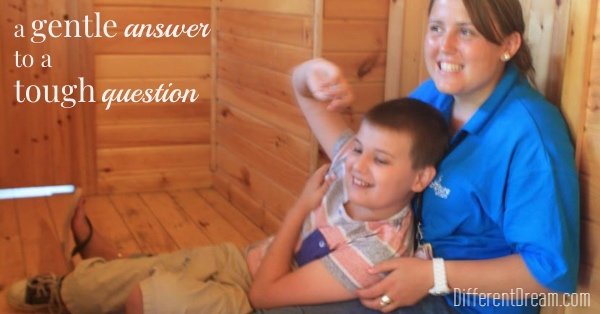
Why did God make me with special needs? When an 8-year-old boy asked his parents this question, they sought the advice of Mark Arnold, today’s guest blogger. He turned his thoughts into this post and hopes you find it helpful.

Made in God’s image?

Starting at the very beginning we see that God created people to be like him, in his image; ā€œThen God said, ā€œLet us make human beings so that they are like usā€¦ā€ So God created human beings in his own likeness. He created them to be like himselfā€¦ā€ Genesis 1:26-27a (NIrV)

Later in the Psalms, we see that God creates each of us individually.Ā You created the deepest parts of my being. You put me together inside my mother’s body. Psalm 139:13Ā (NIrV) The passage also tell us that it is good.Ā How you made me is amazing and wonderful. I praise you for that. What you have done is wonderful. I know that very well. Psalm 139:14 (NIrV)

So, we are all made in God’s image, individually, perfectly, amazingly, and wonderfully.

Does that include children with special needs?

Yes. God doesn’t make mistakes. He doesn’t screw up and make second-rate people. Psalm 139: 13–14 applies to everyone. Because God makes each of us individually, there is wonderful diversity in the world. Even identical twins are ever so subtly different.

So why can life be hard for children with special needs?

Perhaps this is the ā€˜question beneath “Why did God make me with special needs?” Maybe what he wanted to ask was this:Ā If God made me this way, why is life sometimes hard for children like me? Is God cruel to have made me this way?

My answer is that God isn’t cruel, but he doesn’t promise us an easy life. He recognizes, as we should, that we live in a fallen, broken world. Bad stuff happens. Special needs children can find it hard to be understood and to understand themselves. They may be bullied, abused, locked away. None of this is from God. None of this is his will.Ā But he doesn’t stop these things either. To do so would make us puppets with no free will to choose to do good or to do evil.

However, God does promise that we will never struggle alone. He will always be with us.Ā Be strong and brave. Don’t be afraid… Don’t be terrified… TheĀ LordĀ your God will go with you. He will never leave you. He’ll never desert you. Deuteronomy 31:6 (NIrV)

God Ā also the best life for us that we can live on this earth, a life following him and making the right choices In John 10:10, Jesus says,Ā ā€œI have come so they may have life. I want them to have it in the fullest possible way.ā€ (NIrV)

What does “the fullest possible way” look like for a child with special needs?

Perhaps what brings together the experience of every child, whether they have special needs or not, is the love of God being lived out in their lives and the lives of those surrounding them. If children are loved and celebrated for who they are instead of them being forced to change into someone they are not. If they are included, welcomed, helped to belong. If every child is given the tools and encouragement needed to engage with and explore the world in their own way, then they can live life in “the fullest possible way.”

Maybe the question to ask is not, “Why did God make me with special needs?” Ā but “What can we do to create an environment where everyone has life in all its fullness? What can we do to enable each unique individual, each hand-crafted, wonderfully made child of God to thrive, to enjoy life, and be all they can be?”

Do you like what you see at DifferentDream.com? You can receive more great content by subscribing to the monthly Different Dream newsletter and signing up for the daily RSS feed delivered to your email inbox. You can sign up for both at the bottom of this page.

By

Mark Arnold is the Additional Needs Ministry Director at Urban Saints, a leading national Christian children’s and youth organization. He is co-founder of the Additional Needs Alliance, a national and international advocate for children and young people with additional needs or disabilities. Mark is a Churches for All and Living Fully Network partner, a member of the Council for Disabled Children and the European Disability Network. He writes an additional needs column for Premier Youth and Children’s Work (YCW) magazine and blogs at The Additional Needs Blogfather, He is father to James, who has autism spectrum condition, associated learning disability, and epilepsy. To find out more about how Mark’s work can help you, contact him at: marnold@urbansaints.org or @Mark_J_Arnold.

Author Jolene Philo

To get posts delivered to your inbox, enter your email address:

Delivered by FeedBurner

Archives

Categories

Related Posts

5 Powerful Ways Special Needs Parents Impact the World

5 Powerful Ways Special Needs Parents Impact the World

5 Powerful Ways Special Needs Parents Impact the World

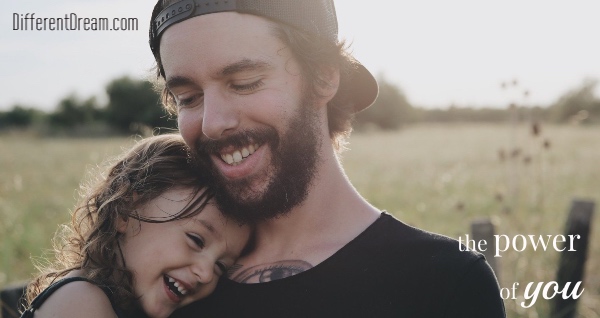
5 powerful ways special needs parents impact the world may sound hyperbolic to people looking in on the disability community. But I’ve been part of a caregiving family all my life, and I assure you that special needs parents impact the world every single day. We just don’t realize it.Ā In fact, we tend to discount the importance of what we do. To see if that’s true for you, read through the following statements.

  • When someone asks about my job, I say things like “I’m just a mom” and “I’m just a dad.”
  • I sometimes think other people contribute more to society than I do.
  • I sometimes think my life is too ordinary to make a difference.
  • I rarely ask our physician questions about treatment options for my child because the doctor is the expert.
  • I don’t say much at parent-teacher conferences or IEP meetings, because the teachers and administrators know more about education than I do.
  • I care for my child, but that’s just what parents do. It’s no big deal.

If 1 or more of the above statements describes you at least once in a while, you are selling yourself short as a special needs parents. As Bob Newhart said in one of the best comedy sketches ever, you need to stop it because your work caring for a child with special needs is making a huge difference. In fact, here are 5 powerful ways special needs parents impact the world.

To read the rest of this post, please click here to visit the Hope Anew website.

Do you like what you see at DifferentDream.com? You can receive more great content by subscribing to the monthly Different Dream newsletter and signing up for the daily RSS feed delivered to your email inbox. You can sign up at the bottom of this page.

By

Jolene Philo is a published author, speaker, wife, and mother of a son with special needs.

Author Jolene Philo

To get posts delivered to your inbox, enter your email address:

Delivered by FeedBurner

Archives

Categories

Related Posts

Ugly Sweater Cookie Contests and EA/TEF Memories

Ugly Sweater Cookie Contests and EA/TEF Memories

Ugly Sweater Cookie Contests and EA/TEF Memories

Ugly sweater cookie contests and EA/TEF memories. What could they possible have in common? The answer is plenty, thanks to a recent Facebook post by a dear friend named Barb. SheĀ posted a picture about the ugly sweater cookie contest she hosted during her family’s 2019 Christmas gathering and asked Facebook friends to vote for the ugliest.*

Of course, I thought, Barb held an ugly sweater cookie contest at Christmas. That sounds just like her.

We met Barb and her young family way back when, when we lived in a remote town of 92 people in the northwest corner of South Dakota. Her 2 oldest daughters were in my country school classroom, and Barb created beautiful birthday cakes for them each year. Word got out, and since our town was at least 60 miles from the nearest bakery, she was soon creating cakes for all sorts of occasions.

She even created a cake for our EA/TEF baby’s first birthday in 1983. The cake featured a baby-with-a-feeding-tube-and-a-string-coming-out-of-his-mouth. Those who are used to 2020 EA/TEF technology may not be familiar with the 1982 version. Our baby’s feeding tube was a honking, huge Foley balloon catheter. The string went into his mouth, down his esophagus (placed there during a very dicey surgery), into his stomach, and out the feeding tube hole. The two ends were tied in a knot that was untied so dilation tubes could be attached to it when his repair scar needed to be stretched. Our baby endured this process, without anesthesia, about 2 dozen times. Thankfully, modern day dilations are less frequent, more effective, and much more humane.

To read the rest of this post, visit Different Dream’s sister blog, Down the Gravel Road.

Do you like what you see at DifferentDream.com? You can receive more great content by subscribing to the monthly Different Dream newsletter and signing up for the daily RSS feed delivered to your email inbox. You can sign up at the bottom of this page.

By

Jolene Philo is a published author, speaker, wife, and mother of a son with special needs.

Author Jolene Philo

To get posts delivered to your inbox, enter your email address:

Delivered by FeedBurner

Archives

Categories

Related Posts

The Thing About EA/TEF People Don’t Mention

The Thing About EA/TEF People Don’t Mention

The Thing About EA/TEF People Don’t Mention

The thing about EA/TEF that most people don’t mention isn’t just one thing. It’s many things as today’s guest blogger Amanda Alcamo explains. What’s the one thing you would add to what she says? Share your one thing in the comment box below.

The thing about EA/TEF that most people don’t mention is the utter shock that comes over you when the surgeon breaks the news. We had no idea that there was anything wrong with our little one until the day after he was born,Ā when IĀ finally got to hold him for the first time, I noticed a small tube coming from his mouth. I recall not being too focused on that as much as the fact of this blessing that I was able to hold in my arms.

It wasn’t until hours later when the surgeon came into my room and explained what he was going to do. ā€œYour son was born with what we call tracheal esophageal fistula with an esophageal atresia. Basically, his esophagus only grew the top half and then was capped off while the bottom half actually grew into this trachea.ā€

My response was, ā€œExcuse me what?ā€

As he explained it again and drew a diagram all I could think about was How did no one notice this before he was born? and When can I take him home?

Our surgeon said there was no easy way to determine that this is something babies have prior to birth and that it’s very rare. He was also extremely confident that our baby would go home in about 2 weeks.

The next morning we all rolled down to the surgery wing of the hospital. I leaned over my sweet 2-day-old baby’s face and whispered, ā€œToday is the day the Lord has made, I will rejoice and be glad in it.ā€ (Psalm 118:24)

Nearly 3 hours later we were able to see our sweet boy. His surgery was successful, and we took him home just over 2 weeks later. But the fear and unknown has continued for years.

Life withĀ anĀ EA/TEF kiddo is different, challenging, and sometimes scary. The dozens of time we have to explain his situation toĀ DrsĀ or teachers can be exhausting. But something sticks in my mind every time I begin to doubt that we endure this for a purpose. Each person we explain this to may not have a personal relationship with Jesus yet. We do. And we know that the God created Isaac formed our son in my womb. He gave our baby life so that we have opportunities to share about God’s perfect love, His grace, and His strength when we are weary.

This past summer we learned of another defect with our son’s bronchial tubes. He endured another long surgery to have his left upper lobe removed. Even then, exhausted, tested, and weary, I found myself dozing off in the waiting room during the procedure. I reminded myself of Psalm 118:24 again.

ā€œToday is the day the Lord has made, I will rejoice and be glad in it.ā€Ā 

It is, and He did.
I did, and I am.

Our son is a blessing and a warrior. I count it all as a blessing now thatĀ we getĀ to endure this journey in life. Ā Through our son, we are reminded how precious it really is and how loved we really are. That’s the thing about EA/TEF people don’t mention.

Do you like what you see at DifferentDream.com? You can receive more great content by subscribing to the monthly Different Dream newsletter and signing up for the daily RSS feed delivered to your email inbox. You can sign up at the bottom of this page.

By

I am a working mother to Isaac, our sweet 3-yearold EA/TEF blessing and wife to my amazing husband Jacob. When Isaac was born in 2016 we had no idea what our life would be like raising a child with such a condition but with every illness we have tried to endure keeping Christ in the forefront. Raising a child with such needs and facing the unknown led me down a dark path of lonelinessĀ and blaming myself. Through a therapist and my family I came to terms with the reality the PTSD for parents of kids with chronic conditions. I continue to share the good news of Christ and His hope, joy, and freedom with all who hear our story.

Author Jolene Philo

To get posts delivered to your inbox, enter your email address:

Delivered by FeedBurner

Archives

Categories

Related Posts

20/20 Hindsight about our Child with Special Needs

20/20 Hindsight about our Child with Special Needs

20/20 Hindsight about our Child with Special Needs

20/20 hindsight about our child with special needs was a long time coming.

When our son was born in 1982, the doctor said he had a tracheoesophageal fistula TEF, now known as esophageal atresia (EA) or EA/TEF.

We were young.
We were first time parents.
We were expecting a healthy baby.
We were blinded by fear after our newborn’s life-threatening diagnosis.

In those early days, we couldn’t imagine having 20/20 hindsight about our child with special needs. 10 years later, we had an inkling that hindsight might develop. 20 years after that, we sensed it was developing. Even so, we were surprised that it took until 2020 for our 20/20 hindsight to come into sharp focus.

It was worth the wait.

Nearly 38 years after the birth of our beautiful baby boy, hindsight reveals how his special needs diagnosis transformed us from a young, scared, and unsure couple into braver, confident parents. Here are 5 of the many means God used to complete the transition.

#1: Bad Things

The day our child was born, we discovered that bad things do happen. In the years to follow, we discovered that we and our child could survive and thrive despite

multiple surgeries, procedures, and tests for our son,
years of sleep deprivation for us,
mental health issues for all,
and huge medical bills.

Despite all that and more, we are still here. And we are thriving.

#2: Surgeons

In the years after our son’s birth, we learned that surgeons are a blessing from God, and surgeons who saw our son as a person and not a condition were a double blessing.

To read the rest of this post, visit Key Ministry’s blog for parents raising kids with special needs.

Do you like what you see at DifferentDream.com? You can receive more great content by subscribing to the monthly Different Dream newsletter and signing up for the daily RSS feed delivered to your email inbox. You can sign up at the bottom of this page.

By

Jolene Philo is a published author, speaker, wife, and mother of a son with special needs.

Author Jolene Philo

To get posts delivered to your inbox, enter your email address:

Delivered by FeedBurner

Archives

Categories

Related Posts