by jphilo | Mar 29, 2013 | Family
photo source
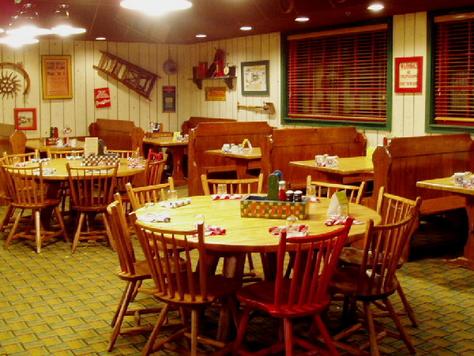
Mom and I ate lunch at The Machine Shed on Tuesday. She loves to go to the all-things-farming restaurant for two reasons. First, the wall and ceiling decor consists of small farm machinery, farm advertising, and farm kitchen utensils in common use when she grew up in the 1930s and 40s. Second, the menu includes her two favorite sandwiches: patty melt and rueben.
This week, she ordered the patty melt. Medium rare. While we waited for our food to arrive, she surveyed the room. A smile played at the corner of her lips. She pointed to a white metal sign with red letters on the wall near our booth. “Ivar owned an Allis-Chalmers implement dealership for a while.”
Then her gaze settled on a lard bucket sitting on a high ledge. “Ma used to pack our lunches in lard buckets.” She started to giggle. “One time, a boy from school had a dead civit cat and started teasing my sister Ruth on the way home.”
“What’s a civit cat?” I asked.
“A kind of skunk,” she explained. “Ruth got so mad she whacked him on the head with her lard bucket. Hard enough that the kid passed out for a few minutes.”
I smiled “I’ll bet he never bothered her again.”
“No,” Mom agreed, then shook her head. “But ruined the lard bucket.”
She looked around some more and pointed at what looked to me like a giant wooden fork with curving tines. “We had one of those,” she said. “But I can’t remember what it’s called.”
“A hay rake,” I suggested.
“No.” She shook her head. “A scythe maybe?”
“Or a swather?” I tried again.
“I’m not sure.” She frowned. “I used to know all that stuff.”
My heart sank. What could I say to a woman who read Gone With the Wind in one long sitting during high school, who aced every test in high school and college, who earned her Masters Degree while teaching full time wile caring for an ailing husband and raising three young kids?
Then her smile returned and she looked my way. “Say,” she said, her eyes twinkling, and her face feigning confusion, “do I know you? What’s your name?”
We laughed together, and now, I can hardly wait to make her smile when we eat dinner with her on Easter. Because she was right about the name of the giant wooden fork with curving tines.
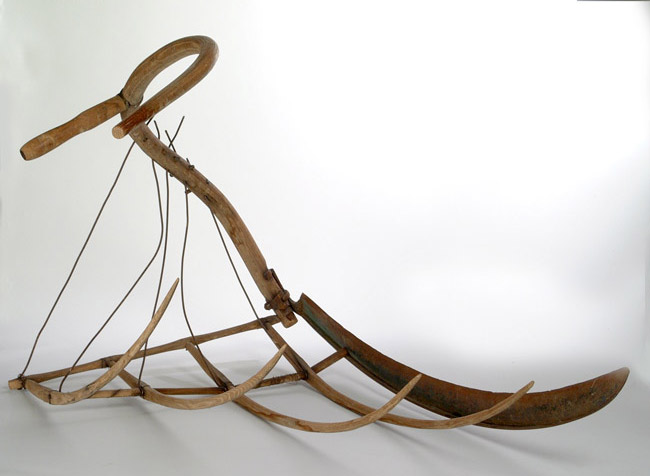
It’s called a hay scythe.
photo source
by jphilo | Mar 8, 2013 | Family
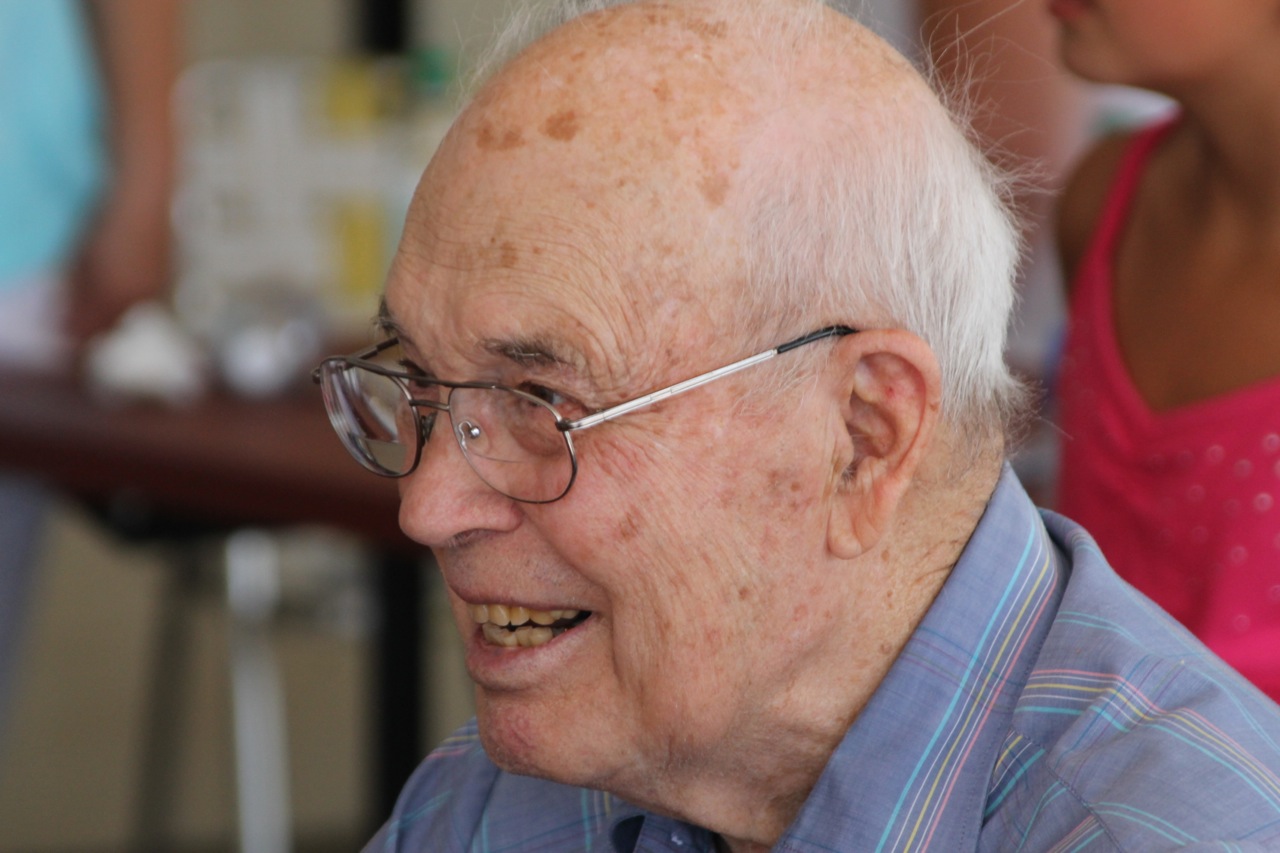
Mom’s last living brother, my Uncle Leo, died peacefully yesterday after 90 years of hard work on this earth. He was the fourth of his parents’ eight children and the youngest boy. Leo took over the family farm, though his father had a hard time handing over the reins. Single-handedly, but with considerable help from his mom, he raised five children on the farm where he’d grown up.
Leo was a farmer and a father, a son and a brother, but he was much more than the sum of those things. He was also a World War 2 vet. He took shrapnel in his foot during the Battle of the Bulge. His injury slowed his fellow soldiers, and finally, they gave him a gun. “We’re going that way.” One of them pointed toward a building in the distance. “Find us if you can,” and left him on his own. He bottled up the terror of that day, and all the terrible days of war he experienced, until decades later a counselor at the VA Hospital encouraged him to tell his stories.
But Leo was more than a a survivor of World War 2. Mom said he’d been an eager student during his years in country school and an avid reader. In one of my last conversations with Uncle Leo, he said he’d always dreamed of going to college and studying history. Family obligations thwarted his dream, but he read voraciously. He loved history, and he loved maps, and his pleasure in them didn’t dim until after his 90th birthday.
But Leo was more than a World War 2 vet. He was royalty, crowned Pipestone County Health King at some point in his school career. The crown earned him a trip to the Minnesota State Fair, where he competed in and won the title of Minnesota Health King. That title made him eligible to compete in the national Health King Contest at the Chicago World Fair, but he caught a cold on the train to the Windy City and had to go back home.
Even so, Leo proved himself worthy of the Health King title during the long years when he cared for his wife, Anna, who suffered from Alzheimer’s. After she died he continued to live alone on the home place, worrying all who loved him, until he was over 90 years old. In December, during a visit at his son and daughter-in-law’s home, he fell. He went to the hospital and never rallied enough to return home.
In a few days, my brother and mom and I will make the long drive to Pipestone for the funeral. I’ll look forward to seeing his children and their spouses and their children, to seeing my remaining aunts and uncles, and many cousins. I’ll look forward to reminiscing about the old home place with everyone. I’ll go teary-eyed in anticipation the sad playing of Taps, the color guard, and the flag-draped coffin. And all the while, deep inside my heart where my inner child who wants to be a princess lives, I’ll be hoping an official crown will be on Leo’s head, a kingly sash will grace his chest, and his hands will grasp a royal scepter.
Good-by, Uncle Leo, father, brother, uncle, farmer, World War 2 vet, historian, and Minnesota health king. Long live our memories of the king!
by jphilo | Nov 5, 2012 | Reviews
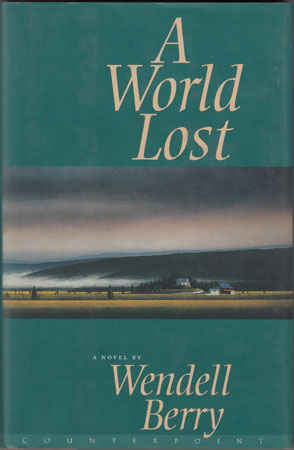
A week ago, I closed the slim volume of Wendell Berry’s Port William novel, A World Lost with reluctance. Since Wendell Berry’s books came to my notice twice in the same month a few years back–first through a book review that cited Hannah Coulter as an example of quality literature from a Christian world view, and then through my son who was reading Berry’s agrarian essays–I’ve greeted the end of each novel with the same reluctance.
Berry’s prose is poetic (he’s written several volumes of poetry, too) in the charming manner of southern writer. His characters are finely drawn, deeply flawed and likable, constantly evolving. The town of Port William and the surrounding countryside where the novels take place in the 1920s through the 1950s are whole and real. The setting stirs my earliest memories of visits to my grandparents’ farm at the end of that era. Berry’s ability to authentically communicate his faith without preaching or sanctimony is the lynchpin of his writing. Like Marilyn Robinson in Gilead and Home, Berry’s belief system infuses his writing and characters.
A World Lost is written by Andy Catlett, a Port William native who is revisiting the death of his beloved Uncle Andy for whom he was named. The uncle’s murder occurred fifty years earlier when the narrator was ten and the facts were kept from him. The narrator gently and quietly unearths the truth, and he ends his quest with a description of the Christian’s heaven and hope that brought me to tears.
One by one, the sharers in this mortal damage have born its burden out of the present world…At times perhaps I could wish them merely oblivious, and the whole groaning and travailing world at rest in their oblivion. But how can I deny that in my belief they are risen?
I imagine the dead waking, dazed, into a shadowless light in which they know themselves altogether for the first time. It is a light that is merciless until they can accept its mercy; by it they are at once condemned and redeemed. It is Hell until it is Heaven. Seeing themselves in that light, if they are willing, they see how far they have failed the only justice of loving one another; it punishes them by their own judgment. And yet, in suffering that light’s awful clarity, in seeing themselves within it, they see its forgiveness and its beauty, and are consoled. In it they are loved completely, even as they have been, and are so changed into what they could not have been but what, if they could have imagined it, they would have wished to be.
That light can come into this world only as love, and love can enter only by suffering. Not enough light has ever reached us here among the shadows, and yet I think it has never been entirely absent.
Remembering, I suppose, the best days of my childhood, I used to think I wanted most of all to be happy–by which I meant to be here and to be undistracted. If I were here and undistracted, I thought, I would be home.
But now I have been here a fair amount of time, and slowly I have learned that my true home is not just this place but is also that company of immortals with whom I have lived here day by day. I live in their love, and I know something of the cost. Sometimes in the darkness of my own shadow I know that I could not see at all were it not for this old injury of love and grief, this little flickering lamp that I have watched beside for all these years.
At the end of each Wendell Berry book, I close the cover with reluctance for one over-riding reason. I do not want the little flickering lamp of hope illuminated in his beautiful prose to go out.
by jphilo | Nov 3, 2010 | Family
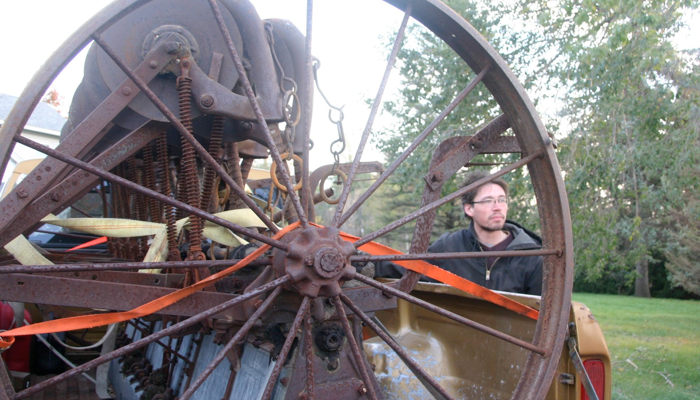
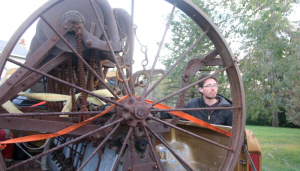
Rumblefish arrived Friday evening while I was at the evening session of our church women’s conference. So I didn’t witness the truck’s majestic sweep up the driveway. With Allen driving, new daughter Abbey and dog packed in the cab and an antique piece of farm machinery in the back, it must have been a sight to behold.
My first encounter with our son’s pride and joy came when our overnight guest, the conference speaker drove home late Friday night. The monster in the truck bed waved its round metal fingers when we climbed out of our respective cars. With Halloween right around the corner, the leering piece of farm history was more than a little disconcerting.
The contraption was slightly less threatening in the cold light of day. Allen gave Hiram and me a quick tour of its finer points – a bunch of handles and levers that impressed my hubby to no end, but left me totally bored, bored, bored. Then, the two men went into the mechanical trance that overtakes Philo men in the presence of machinery. They launched into a discussion about gears and welding and other boring stuff.
I, on the other hand, went into my capture-the-moment mode. After all, the thing (It has something to do with grain and boring holes, and it is made to be drawn by horses, not a tractor. So if this were an essay question the explanation would be worth at least half-credit.) is the first tangible piece of our son and new daughter’s dream of owning an organic farm and working it with horses.
If that isn’t a moment to capture, what is?
Admittedly, the moment wasn’t all that pretty, with Hiram and Allen rolling their eyes at the sight of the camera. Rumblefish could use some sprucing up, it’s muffler needs voice lessons, and a dozen cans of spray paint would work wonders on the machiney thing. But there was a weary beauty to the spokes and springs, and a wondrous imagining of fields and crops and critters as our son shared this small beginning of an upcoming chapter of life.
So I concede that the acquisition of the the horse drawn whatever-it-is, which wintering in a farmer friend’s chicken coop, is a good first step into future – even though encountering it in the dark of night prickled the hair on my neck.
Still, I’m hoping the second step isn’t the horse.